Day 24 (Embry)

April 7

Valencia

This is Embry again, writing my occasional blog contribution. I am happy to report that Joe’s blogs for the past week have been 100% accurate: no six-meals-a-day-exaggerations. As you can tell from his reports, we have continued to have an amazing time here in sunny southern Spain. We knew nothing at all about Valencia, and it has continued to surprise us with its charm day-after-day. It is hard to say what is most appealing, but here are a few things: (1) as with many European cities, each time you turn around (especially in the older part of town) you bump into some beautiful piece of old-to-ancient architecture; my favorites are the huge carved wooden doors–usually with equally beautiful hardware—each a unique work of art, of which there are hundreds; (2) people-watching over café con leche in some lovely square; (3) Semana Santa or Holy Week, of which you have a full report from Joe; and (4) the friendly atmosphere that is welcoming to strangers like us, and virtually devoid of tourists, which stimulates our use of broken Spanish.

Joe thought I might briefly recap some of the best “tourist attractions” we have visited, since he has been concentrating on other things. I don’t want to go into tedious, lengthy detail which you can get on-line or in a guide book. But I do want to stimulate your interest in this beautiful part of the world, which is not on many American “must see” lists (although I did notice that the next GW alumni tour is to Valencia!). I will list them in the order we have seen them.

  1. Madeira: This is a lovely island off the coast of Africa, which is home to 250,000 people. It is an autonomous region of Portugal that, only in the 1970s, was “released” from the dictatorship of Salazar. Land was redistributed into smaller plots, and it is now rather prosperous with a thriving tourist industry (including receiving cruise ships like ours, which dropped us off for a day). Because the island was formed by a now-extinct volcano, the soil is rich, but the hills are so precipitous (with many beautiful waterfalls) that farming is by hand (no tractors). In spite of this, because of fertile soil and lots of sun and rainfall, they produce a lot of fruits, such as bananas and grapes. They produce a good sweet wine , and they are proud to say that the signing of the U.S. Declaration of Independence was toasted with “Madeira”. This is a good place to come for a winter vacation, but don’t expect sandy beaches. (You can go by ferry to a near-by island for one).

IMG_7919 IMG_7928

  1. Seville: We had a second cruise-ship stop in Cadiz, where we took a bus to Seville. We had been there once before, when Andrew was three years old, so a long time ago! It is a lovely, walkable city (as we recalled), and the best thing we visited was the Alcazar, the old Moorish palace which is surprisingly well-preserved. It was taken over by the Christian king “Peter the Cruel” (and one can imagine what happened to the Moors under his watch if that is what he is called!). The whole history of this area of Spain is incredibly sad, since—with the “reconquering” of the area (actually quite a misnomer)—they expelled the Jews and then the Muslims—and with this destroyed the culture, knowledge, and artistic capabilities of a whole multi-cultural civilization.   (We were not as fond of the huge cathedral, which kept little of the beautiful Moorish architecture of the Alcazar.) Still, Seville is worth a visit and an overnight stay if you can.

IMG_8104 IMG_8145

  1. Granada: The third cruise ship stop was at Malaga, where we took a tour to Granada to see the Alhambra. This is the most-visited tourist site in Spain, and you cannot get in without a pre-arranged tour. They have about 8,000 visitors a DAY, throughout the year. This was the palace of the last Muslim Caliph, Boabdil and was miraculously saved from total destruction several times. Built in the 13th century, when this final Muslim kingdom was conquered by Ferdinand and Isabella, they knocked down 7 of the 8 palaces, but left this one. Our guide speculated that they could not bear to destroy something so beautiful, so that “gave it to their friends,” who kept it more or less intact for a couple of centuries until it began to fall into ruin. Then in the Napoleonic wars it was occupied and used as stables by Napoleon’s army, until they quickly evacuated and failed to destroy it as they usually did when they left (according to the guide!). Again it was abandoned and fell into ruin until it was discovered by American Ambasador, Washington Irving–who wrote the Tales of the Alhambra and made the place famous. This led to tourists and a subsequent renovation by the Spanish government.

IMG_8186 IMG_8204

  1. Valencia area: Aside from trying to “live like locals,” we have also spent some of our time “being tourists.” Our top recommendations so far for tourists include: (1) the lovely late-Gothic Cathedral (15th century), with added decoration from the 17th and 18th centuries (but not at all an “overdone hodgepodge” as in Seville); (2) the beautiful central market that is another architectural gem; and (3) Xativa Castle, which is about an hour out of town where we took our only car trip. This amazing place is at the top of an apparently-impenetrable precipice, but in reality it has been conquered and re-conquered several times, through various siege-warfare techniques from starvation to cannons. The large building is where we are staying (seventh floor on the right); and though it may not win any design awards, the apartment is quite nice as are the views.

IMG_8329 IMG_8374

The photo below is a typical sunset as viewed from our window.

IMG_8322

Visit me on Substack!
Subscribe to my Substack!

Day 22

April 5

Valencia

Today is Easter Sunday, and we have pretty much done it up right. In fact it all started about four days ago on what Episcopalians call Maundy Thursday, the day of the Last Supper. Embry read somewhere that Valencia was famous for its Holy Week festivals, which took place in the Maritime District, only a few blocks from where we are staying. The first big event was to be a parade of some sort; and around 8:00 pm as we walked over we soon heard the beat of drums—two loud, slow beats followed by three fast softer ones. Boom, boom, rat-a-tat-tat. Crowds five or six deep were gathered along the sidewalks of one of the narrow streets in this medieval part of town; and we squeezed in to witness a solemn procession of 25-30 people—mainly men but some women and a surprising number of teenagers and children– all dressed in black robes, followed by a band of drummers, constantly performing the same beat—boom, boom, rat-a-tat-tat. In front of them similar groups had already passed, and behind them were many others. The various groups in the procession were organized the same way—a leader in front, four or five in a second row, usually men, then a row or two of women, many carrying infants and then the teenagers and younger children. All the participants looked very serious, just like in a Sunday processional you might see at All Souls Church. And the people crowded along the sidewalks looked like church goers as well, with serious faces and very little talking. The only thing distinguishing one group from another was the color of their vestments, which included just about every color and combination of colors you could imagine. At the time we could not tell how large the parade was; but it went on for about an hour, and we figured we joined it somewhere in the middle of the parade route.

As the last marcher passed, we fell in with the crowd and followed the parade for several blocks until we came to a small plaza situated in front of a Catholic Church where the action had paused and hundreds of marchers and drummers were standing around talking casually. Something was going on in front of the church—we could not tell what—but fortunately there was a bar next door. While I was taking photos, Embry grabbed one of the few free sidewalk tables and quickly ordered two beers.

Then things began to take a strange twist. After remarks made at the church, all the adults in the parade put on large pointed hoods covering their faces, exactly like the Ku Klux Klan wear, reassembled in full hooded regalia and then continued the solemn march—boom, boom, rat-a-tat-tat. We finished our beers and headed home. It was close to 11:00 pm.

What was THAT all about? Klansmen? The Inquisition? Executioners?

The parade the next day, Good Friday, started earlier, at 6:00 pm instead of 8:00; and by this time we had done enough research on the internet to learn that the pointed hoods were for those who were “penitent” and that this ritual had been going on since the Middle Ages. There were 30 different groups participating and 30 different bands, each one representing a kind of brotherhood or fraternity associated with one of the churches in Valencia . The most interesting thing for us was how many children of all ages, from infants and toddlers up, were involved.

We did not know what to expect for the Good Friday parade. Having a little better idea of what was involved, we got to the parade route early and were strategically positioned at a plaza, near where the march got underway. This time the crowd seemed to be much larger and we could see various floats lining up depicting various scenes from the Passion. This march was like the first march in some ways—the vestments and robes seemed to be the same, and this time the hoods were worn from the start—but it was also very different in other ways. There were many more women and children; and everyone was dressed either in vestments or in costumes representing various Biblical characters—Jesus, Mary, Salome, Pontius Pilate, Caiaphas, Roman soldiers, various disciples, and so on (38 characters in all we later read in one of the pamphlets we picked up). Also this march moved very slowly with participants taking hesitation steps. Heads were bowed, faces glum and everyone, even the smallest children, in character. No one smiled. Ever. The bands had added brass instruments, and the music was one funeral dirge after another. The crowds were somber as well with few people talking and many showing expressions of awe. People were not crying, but they certainly could have been. The closest thing that I can think of is the mood associated with the funeral procession following the death of President Kennedy. And it went on and on and on. We left after a couple of hours, drained and exhausted. I was basically speechless.

IMG_8563

The final parade was today, Easter Sunday. We got there early again and this time wandered through the staging area before finding the parade route. The somber robes and vestments had been replaced by dazzling whites and the hoods were off. The atmosphere was totally different—upbeat, joyous, high energy and all kinds of colorful costumes worn by the women and children. And this time, again, everyone, even the smallest kids, was in character, grinning and smiling and tossing flowers into the crowd. The funeral dirges were replaced by upbeat marches and show tunes, woodwinds were added, and the pace was brisk. The crowd was the largest yet, well into the tens of thousands. We calculated that there were over 2,500 participants just in the parade!

And along the route, there was hugging and embracing, laughter and joy. Everywhere. This time we waited out the entire parade and filed in with the crowd after the last marcher passed, returning to the apartment exhausted but smiling.

I felt as if—perhaps for the first time—I had just experienced the passion, death and resurrection of Jesus Christ.

IMG_8600

And we also managed to get in a “real” church service as well, attending the ten o’clock mass at the cathedral downtown. It turned out that the big mass was at eleven; and the one we attended was in one of the chapels, the one with the guaranteed, real, authentic Holy Grail, a huge solid gold cup behind bullet proof glass. There was no music, and the service was low key and intimate. The chapel held about 100 people and was full. Even though we could not understand a word, the service was meaningful; and Embry was particularly impressed with the elderly priest, who had a kind smile and appeared friendly. I would argue that not understanding a word might actually be a blessing in some respects, but that is a subject for another time.

The big service had already started when we came out of the chapel, and the huge nave of the Cathedral was mostly full by the time we eased out just after the Gospel reading. All of the service was chanted; and there were all the bells and whistles—incense, candles and clergy all decked out, an All Souls service you might say—on steroids.

Quite a Holy Week here in Valencia.

IMG_0981

Visit me on Substack!
Subscribe to my Substack!

Day 19

April 2

Valencia

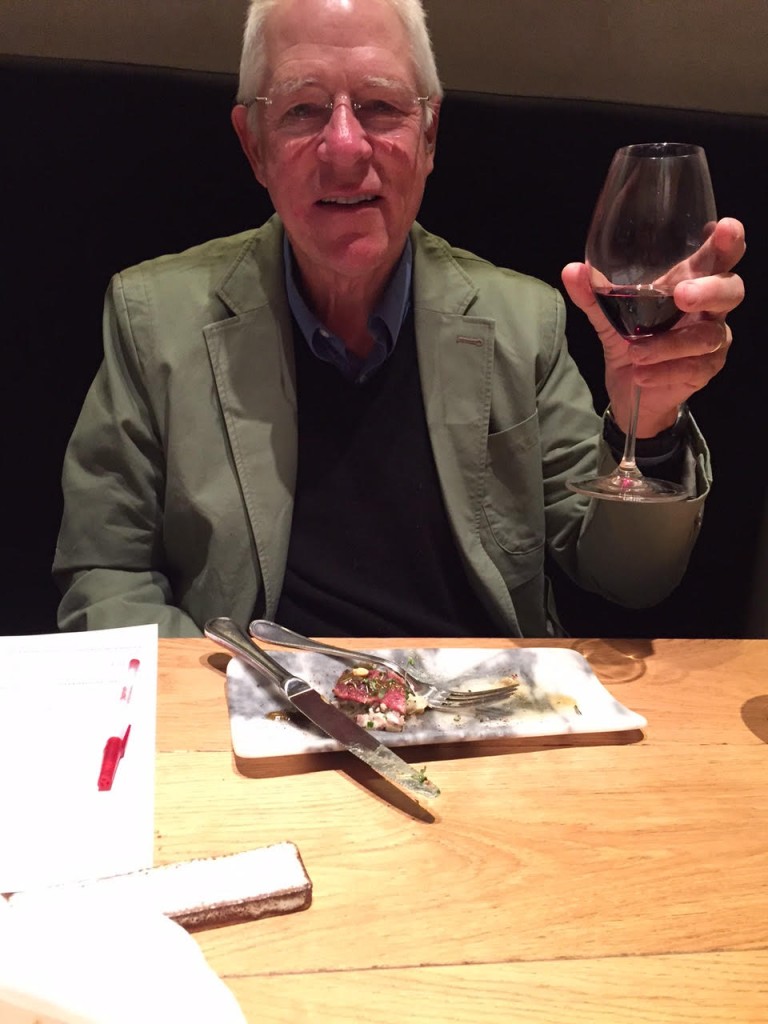
bdayYesterday was my birthday. To celebrate, Embry found a promising restaurant, called “Richard Camarena” in one of the guide books. We asked Anais to make a reservation and showed up promptly at nine via cab at what we thought was the proper address, hoping that we would not be too early. The cab stopped in front of what was the address, but there was no restaurant or anything else for that matter—only a large, black imposing door. By the time we concluded that we were obviously at the wrong location, the large black door suddenly opened, and a fashionably dressed young couple dashed in, greeted by a guy wearing a tux and no tie. We followed.

We were at the right place after all. We were greeted warmly by another guy in a similar outfit and quickly escorted to one of the dozen or so tables, most of which were surprisingly already occupied (at such an early hour) by what appeared to be a pretty young, hip crowd—mostly in their thirties, guys wearing levis, designer tee shirts and blazers or sport coats, women also in jeans and high heels. The décor was understated and Spartan with concrete floors and simple wood tables with no tablecloths. The dim lighting, however, created a cozy atmosphere; and excellent black and white photographs–mostly of nude women– decorated the walls. The most surprising thing was how few tables there were and how much space there was between them. You could have—and in the US would have—easily doubled the number. At the end of the room was an open kitchen with at least a half dozen guys in chef hats feverishly working away.

Within a couple of minutes, the first of our three waiters came over and greeted us in English. In English! First of all, how could he have known we weren’t Spanish since we are not tourists but are living the Authentic Life of locals? And second, how did he pick up English? In Australia, it turns out, where he spent a year; and his co-waiter, who also spoke good English, spent time in London but was actually Italian.

And so the evening began.

We were provided a simple, one page menu (in English!), which was titled “Our Proposal for Today” and listed 16 dishes, the last three being desserts. We only had to make one decision, however, how many of these dishes to order—six or nine or eleven. Richard, the owner and executive chef, would determine which dishes we got. I decided to go with nine and Embry six. And the prices were not exactly what you would call cheap, especially here in Valencia where we have been eating lunches for two, including beer, for under 12 euros—75 euros for the six dish option and 90 euros for the nine dish option.

It turned out to be a bargain.

There is no way I can do justice to what came next. The waiter first unwrapped a bundle tied with a gold ribbon, which contained the bread. Then the first dish came—and this one was not even on the menu but courtesy of Richard—a “drink” though really more like a soup, which contained wild ranch chicken juice, wine and radishes, followed by a second “gift” from Richard, a dish of spring onions, cream butter and black garlic. The other nine dishes followed. The first was “Courgette peel, steak tartar, fresh strawberries, cottage chease [sic] and capers emulsion,” –and that is just one dish! Then oysters from Valencia, avocado and “horchata” of galanga (no, I do not know what any of this is); and on it went finishing up with two desserts “slightly spicy orange salad and peanuts” and “sweet carrots, yogurt and roasted coconut,” which was one of the best deserts I have ever eaten even though I hate carrots and yogurt and coconuts.

And when Embry mentioned that this was a birthday celebration, another dessert, a small cake with a candle and ice cream, appeared.

And as good as the food was—and I believe I can say it was the most delicious I have ever had—the service and the presentation of the food were even more impressive. We got a change of silverware between each of the 11 dishes and three napkin changes. (Beats me why there were three.) The time between dish changes was usually only a couple of minutes, and all three waiters were friendly and attentive. The third waiter, by the way, was a drop-dead gorgeous blond, also thirty-something. And each dish came in museum quality bowls and pottery of all shapes and sizes. And did I mention the wine? Incomparable.

At 11:30 we had finally finished and were ready to head home. The other tables were still mostly occupied, and no one showed any sign of leaving.

Now I know that by my telling this story you may think that combined with my cruise ship stories I am hopelessly obsessed with food and am a total dissolute, which, of course, would not be far from the truth. In my defense, however, I hasten to point out that the dishes were tasting portions and therefore rather small. So it is not as excessive as you might think. And, of course, to truly understand a country you must taste its food. One way to look at this over-the-top behavior is to think of it as research. Can there be any doubt based on this research where Spain stands?

Visit me on Substack!
Subscribe to my Substack!

Day 17 (Joe)

March 31

Valencia, Spain

valenciaLeg 2 is now officially over, and we are on terra firma in Spain. Three days ago Leg 3, the House Exchange, began. We will be in Valencia for two weeks.

To be honest I was not sad to leave the cruise ship. Yes, we loved it and would do a crossing again; but the six meals a day, the concerts, lectures, bar scenes, spa routines—it all gets a bit old after awhile.

Now on to the important stuff: We are starting our European land leg with Spain, which by all accounts should be a terrific country. Technically this is not our first time in Spain because we visited the country in the mid 70s, and also the Zuiderdam stopped for two day trips in Spain (along with a stop on the island of Maidera)—one at the port of Malagar, which permitted us to spend a day in Seville, and a second stop in the resort city of Cadiz, where we joined a bus tour to Granada where we saw the Alhambra. Both were terrific, bucket list type of places—extraordinary beauty and a rich history, regrettably not enough time to do them justice in this blog post.

The idea of a house exchange was naturally Embry’s. Hey, anyone can be a tourist. But to truly understand the soul of a country you have got to live there, walk its streets as a common person would, taste food the ordinary person eats, breathe its air, get to know real people —none of the superficial stuff you get as a tourist. So that is where the idea of a house exchange came from—the chance to live the authentic life of a Spaniard. And would anyone doubt that after three days we are true authentic Spaniards? Plus it is free, not an insignificant factor for a Scots-Irish Presbyterian (Embry).

As Embry noted in her blog post earlier today, the Perellos are staying at our house in Washington while we are staying in their small but gracious apartment on the seventh floor of a 20-story high rise, which permits us to see glimpses of the sparkling waters of the Mediterranean about a mile away.

I somehow had the idea that Valencia was a cute- resort-Medieval kind of village, like the ports we visited on the Zuiderdam. Instead it is a dynamic metropolis with almost a million residents with all the hustle and diversity you might expect. There is lots of graffiti (as there seems to be everywhere in Spain), which decorates shuttered store fronts and virtually every inch of alleys behind apartment houses, shops, restaurants, museums, and historic churches. Our neighborhood is about three miles from the old city and could be described as typical middle class. This statement is based on the fact that it is a lot nicer than the neighborhoods between us and the Mediterranean and not as elegant as the neighborhoods in the old city. There are no hotels in the area far as we can tell, and we have heard no one speaking anything besides Spanish. This is definitely not a tourist area, which was the idea, right? And it is quite pleasant and attractive.

There was a bit of a glitch getting here when we realized getting off the train ( a four hour ride from Cardegana, where we disembarked from the Zuiderdam) that we had no way of meeting up with Annais, the Perello’s twenty-something daughter, who was supposed to meet us at the train station. Naturally we had failed to let anyone know exactly when we were arriving at the train station, and the telephone number we had for Annais did not seem to work. But Embry’s guardian angel stepped in; and miraculously Juan Perello answered the phone at our house when we desperately called. Problem solved (He was able to get through to his daughter.) and we took a cab and received a warm welcome from Annais, who is a med student at a local university.

So here are two first impressions of Spain: they eat really, really late and second, they speak very, very, little English.

First about the late meals. To truly appreciate the hardship that this has created for two weary American travellers accustomed to the high life you have to remember that our seating at the Zuiderdam was for the early dinner—5:30 pm. In Spain restaurants do not even open until around nine; and if you get there at 9:30, you will be the only customers in the place. At least this has been our experience so far. On board the ship, at this late hour we would have just completed out sixth full meal of the day and ready for bed. This is taking some getting adjusted to, but we are coming along.

And the language. For some unknown and inexplicable reason the Spaniards do not speak English. Yes, a few do– and fortunately Annais is one of them– but very few. Hasn’t anyone told them that English is now the fully authorized language of the Planet Earth? Everybody speaks English, right? They even speak English in South Africa (where we traveled last year) and I am told as far away as Australia and New Zealand. But not here. (Could it be that we Americans—at least some of us–are spoiled and lazy when it comes to learning languages?) Embry keeps reminding me that I took Spanish at Davidson, which I am sad to report is not coming back to me yet. And Embry even listened to a Berlitz Spanish language course while on the cruise though she is no better than I am at the moment. So our first activity the day after we arrived was to buy a good Spanish phrase book, which it turns out does not exist in Valencia. How stupid not to bring one! I am still working on internet options.

A few other first impressions. Security seems to be a major concern here, similar to what it was when we visited South Africa last summer. There are all kind of security locks and keys associated with the apartment and the underground garage and even electronic security devices which need to be turned on and off, even though we are on the seventh floor of an apartment house with a doorman/guard. This could have something to do with the proximity of what would appear to be a very low income neighborhood only a few blocks away. (And what is all this graffiti about anyway? Yeah, we have a problem in the US but nothing like this.)

The city of Valencia is very large and bustling and the old part of the city very quaint and picturesque. We walked from the apartment all the way to the downtown and around the area (over five miles according to my walking app) and were impressed with all the cafes, fancy stores, and the relaxed atmosphere. I understand that post Great Recession Spain has suffered more than most European countries and still has high unemployment, but on a stroll through the downtown you would never know it. Somebody is buying this fancy stuff and eating the delicious food. The recession is probably felt more in neighborhoods like ours.

(And given the strength of the dollar, prices of just about everything seem like a bargain to us.)

IMG_8273Finally, let’s hear it for city planning. There are more dedicated bike lanes here than I have seen anywhere, even in Denmark; and they are heavily used. And bike-share racks are everywhere. There is also a linear park that used to be a river that was created in the 1950s when the river was diverted following a major flood. If you live anywhere near the downtown you are only a few minutes walk from this delightful and diverse park, which is also heavily used.

And, oh yes, the Spanish people. They aren’t fat like so many of us Americans– at least not anywhere near as many. Maybe it is because they ride bikes. And don’t go on cruises.


Visit me on Substack!
Subscribe to my Substack!

Day 17 (Embry)

March 31

Valencia

Valencia trainHi, this is Embry writing today. Joe thought it would be fine for me to add to his blog from time to time. You might like to hear a second perspective on our “Big Trip,” one which will likely be considerably less humorous but decidedly more factually accurate.

We now have settled down in Southern Spain for a couple of weeks, and so far it’s quite fun. We are living as “normal Spaniards” (such as one can do having a vocabulary that is limited to please, thank you, good day, and about five other words). But we are enjoying the relaxed pace of this city by the sea (third largest in Spain with a metro population of over 2.5 million). We have exchanged our house for the apartment of Juan and Vincen, who are at this moment in our house on Macomb Street , D.C. We are briefly sharing quarters with their daughter, until she leaves for spring break later this week. We just did our grocery shopping and discovered that prices are good here. A large shopping cart of groceries with meat, wine, and vegetables was about $50.

I will not go back over the delightful cruise and our three “land-based tours” of Madeira, Seville, and Granada (the Alhambra). I know that Joe has given you a funny rendition (although exaggerated at times) of that great experience. The cruising was relaxing and the tours were fascinating.

I thought that perhaps you might be interested in why we are doing this in the first place. It was my idea that “someday” when I “retired” (neither of these concepts very concrete in themselves) I would “bum around the world without flying” (a concept that was a TOTAL fantasy that somehow involved trains and freighters). As the “someday” and “retirement” slowly came to mean “maybe next year,” one day this fantasy again came into our conversation; and Joe called my bluff, by saying “Can I come, too?” After recovering from my surprise, I said “Sure!” and the planning for the Big Trip began. He started from the point of view of “complete luxury” and I started from the point of view of “trains and freighters.” (I realize there has been a previous blog concerning the Episcopalian and Presbyterian approach to these things.) We compromised somewhere in between these two extremes.

We discovered that there are plenty of really nice trains in places we wanted to go, but that “freighters” don’t exist any more. It would have to be either cruise ships or container ships, and we settled on one of each (mostly due to scheduling issues in getting across the Atlantic and the Pacific–the options are limited). Joe also was practical in insisting we enlist the help of two excellent travel agents, one of whom helped us plan and make all the reservations for the cruise and Europe, and another who planned the wonderful trip around China. Part of the planning was—not surprisingly—the budget. One problem with retiring is you have lots of time, but no pay check. However, we have McGraw-Hill (former employer) and the Social Security Administration to thank for helping to solve this problem. So, after many complicated logistical and budgetary decisions, our four-month-around-the-world-without-flying trip itinerary emerged. The trip has several “legs”, of which we are now in the third (Valencia).

This leg was planned purely by chance. We didn’t want to be constantly on the move, since taking it slowly was the whole point. Our friends had successfully exchanged houses, so we posted ours on HomeExchange.com, asking for an exchange in early April somewhere in the southern part of Europe, knowing our cruise would take us into the Mediterranean about that time. Juan and Vincen responded (he had studied in Washington and wanted to return with her during Easter break time), so here we are!

That’s just a bit more on why we are doing what we are doing, and why we are where we are, for you today. Now it’s time for a good book and a nap!

IMG_8154

Visit me on Substack!
Subscribe to my Substack!

Day 12

March 26

At Sea

the ship

We are on what will be our last complete day at sea. We made land fall at Madeira at 8:00 am yesterday, some 3,000 miles from Ft Lauderdale, spent the day ashore exploring the mountainous island and are now on a two day voyage which will put us in port at Cadiz , Spain tomorrow morning. A day on shore there and then a day of night sailing followed by a shore day in Malaga and we then arrive in Cartagena on Palm Sunday, March 29, the beginning of Holy Week. Our Atlantic crossing will have officially come to an end.

So not much has happened and a lot has happened, just like it always is when you are at sea.

The days have been pretty much the same—30 knot head winds and partly cloudy skies, temperatures in the low 60s– with more activities and more food than most people could possibly consume in any 24 hour period. Some might say a lifetime.

So here is a brief summary of the cruise ship leg:

It actually is surprisingly satisfying. I say “surprisingly” largely because (as I noted before) of my innate bias as a sailor against big ships. Before this cruise I tended to disparage everything about cruise ships. I now look down from the deck outside our comfortable cabin at a 40 foot sailboat headed out into 35 knot head winds, towering waves and spray everywhere and ask, “Are those guys nuts?” Actually we have not seen any sailboats on this voyage, so it is a hypothetical observation, But you get the point.

The most satisfying aspect of a big ship Atlantic crossing is settling into a relaxed routine, which adds new meaning to the term “low stress.” The big decisions are whether to eat in the main dining room or the casual buffet on the upper deck or whether to work out in the fitness center or do a powerwalk around the deck, to see a movie or watch a live show, to have a drink at the jazz bar or the piano lounge, to use the hot tub or the sauna, to do yoga or Pilates. I mean these are really tough decisions.

The second most satisfying thing is the general atmosphere aboard the vessel. It is the friendliest place I believe I have ever been– mainly because all crew members always smile and always speak to you, no exceptions; and they all seem to really mean it. “Good morning,” “good afternoon,” “have a good day,” “hello, sir” come out of the mouth of every employee regardless of how high or how low they are on the totem pole. I do not know what kind of hospitality training they have Holland America, but they should sell it to everyone on the planet. I honestly believe it would change the world. For example, after a day or two most passengers who otherwise would go to great lengths to ignore strangers find themselves instinctively greeting one another and wishing each other a good day. Lunch or breakfast with fellow passengers you have never met has always been pleasant and enjoyable. Everyone—or almost everyone—is friendly, and what a difference this makes!

Why does it take a cruise ship to make this happen? What if Democratic and Republican congressmen and senators greeted each other with smiles every day as they passed each other in the halls saying “Good afternoon and have a good day”? What if Palestinians and Israelis did the same, or Sunnis and Shias? Tea Party activists and Progressives? Redskin and Cowboy fans? In fact we had lunch with two couples from Dallas yesterday. No problem.

I do not know how hospitality training enters into it, but we are told that the crew of over 700 people from 38 different countries gets along extremely well in what are very challenging circumstances—getting 12,000 delicious meals served daily. (Yes, that averages six meals a day per person, which proves my earlier observation on nutrition. I got this statistic from the exec chef on my “behind the scenes” tour today, so it is the truth.) Laundering every day over 1,000 sheets, 2,000 towels, washing over 15,000 dishes. In one of the talks, an officer stated that if cruise ship HR policies were used throughout the world, maybe we wouldn’t have as any wars. Could be an overstatement but you get the sense that there is an element of truth in this.

The third marvel has to do with the nautical technology that makes this possible. This ship is relatively small by current cruise ship design standards—just under 1,000 feet long, 150 feet high and 120 feet wide. It cruises at between 15 and 22 knots and at full speed can come to a complete stop in two and a half boat lengths, or about a half a mile. For an older design ship it would take three miles. What makes this possible is the use of huge twin “inboard/outboard” props, which can rotate 360 degrees and require no rudder. The ship can turn on a dime and appears easier to dock than “Second Wind,” our 40 foot sailboat. The new technology when it finds its way into container ship design will pretty much eliminate the tug boat industry.

The bridges on these ships resemble a set out of Star Trek . Paper charts are gone and scores of computer screens monitor every conceivable vital sign as the ship pretty much sails itself. I am sure there is plenty for the small number of bridge officers to do, but during the brief time I was on the bridge during my tour it seemed like they were mainly wandering around checking all the screens.

And everything on the ship is recycled, purified or disposed of in port. Drinking water is made from the sea.

So the bottom line is that Leg 2 has been terrific, far exceeding expectations, which were not all that clear in the first place since we did not know what a repositioning cruise entailed. Would we do it again?  Definitely, though not without a six month advance notice to allow time for fasting and radical weight reduction to allow room for the six meals a day. This leg should go on your bucket list.

Photos forthcoming.

Visit me on Substack!
Subscribe to my Substack!

Day 7

March 22

At Sea

Zuiderdam

We are now more than halfway across the Atlantic and in four days will make our first landfall at the Portuguese island of Madeira. The weather overall has been mixed. The first two days were drop dead gorgeous—clear skies with temperatures in the 80s. It would not have been good for sailing, however, as winds never made it above five or six knots. Day 3 was a solid 10 for sailing with winds at 12-15 knots the entire day with hardly a cloud in sight. It clouded up that evening ushering in fresh breezes, which on Day 4 and 5 built up to more than 30 knots on the nose along with 20-25 foot seas and temperatures peaking in the mid 60s. Not what I would call ideal sailing conditions and a reason to be thankful that we are on a I,000 foot cruise ship, not a 40 foot sailboat. How do sailors cope with such conditions for days at a time?

Now it is pretty again with winds at 10-12 knots and temperatures back in the mid 70s.There are no sailboats to be seen out here, however—or any other vessels for that matter. Since we set sail from Ft Lauderdale almost a week ago, we have seen only two ships, both container ships. If you were on a sailboat and got into real trouble, you would not have a lot of help. I am trying to recall if I ever had a real urge to do an Atlantic crossing in a sailboat, and I think the answer is no. In any event it is surely no right now.

I also am beginning to understand how cruises can become addictive and why every person we have talked to so far has been on multiple previous cruises. Every day is the same, and yet every day is different. The schedule is more or less the same with set meal times and various activities that are more or less the same. But the sea is forever changing, and you can pick which of the 60 or 70 daily activities you want to do or do none of them. And there are alternative, casual dining venues providing opportunities for breaks from the elegant, formal main dining room.

We spend an hour or so each day exercising (walking on the main Promenade deck around the ship or using the tread mills and bikes in the fitness center.) Embry has gone to the spa and taken Palates and yoga classes, and we both have attended several lectures on various topics, mainly history. Embry has already finished a couple of books. I am 50 pages into my first. At one point I thought it might be interesting to have a contest allowing readers to vote for which number would be higher when we disembark from the ship in Spain– the pages that I have read in books or the pounds I have gained. (A very high percentage of our fellow passengers would fall into the category of obese, which I suppose is due in part to their age , that the are mainly Americans, and the number of previous cruises they have taken. Do the arithmetic:10 previous cruises at 15 pounds a cruise. Starts to add up.)

Fellow passengers also are generally retired folks like us, and everyone we have met so far is friendly. No one talks politics, and I could well imagine we may be the only two Democrats on the boat. Of the 1,700 passengers, only a handful are people of color. There are a bunch of affinity group activities that happen daily including the LGBT gathering, Friends of Bill W., “Fellow Veterans,” and “Singles and Alones.”

There is also much to do if you are so inclined: duplicate bridge, dancing with stars, photo lectures, cooking lessons, scavenger hunts, blackjack tournaments, trivia challenges, golf putting contests, ping pong tournaments,

bingo, gambling, wine tasting, model boat building, paper airplane contests and much more.

Or you can just sit on the deck and watch the waves to by, which is mainly what I do. And write blogs.

And eat.

Visit me on Substack!
Subscribe to my Substack!

Day 5

March 19

At Sea

For those who have read the typical day of a cruise ship passenger, do not get the idea that everyone is typical or that we are necessarily following the typical schedule. (Yes, we are getting at least an hour of vigorous exercise a day and are going light on breakfasts and lunches.) But it is hard not to miss the observation that there is a bit of self indulgence, perhaps even decadence, on this leg of our adventure. Does this sound like Joe and Embry?

Well, first of all we had no idea what this leg would be like. Our goal was simply to get across the Atlantic without flying. Our travel agent, D’Lane, figured this part out. The ship was being moved; and because of the low demand for transit cruises, the price was low. We figured the ship would be mostly empty with few amenities. Anything but. Way to go, D’Lane!

But to fully appreciate the dynamics involved in the Big Trip you need to know two things and only two things about us: Embry is a Presbyterian and I am an Episcopalian. (Yes, we both are active members of All Souls EPISCOPAL Church in

DC, but Embry was brought up Presbyterian and insists on identifying herself as such.)

First a word on Presbyterians. Presbyterians are earnest, hard working and serious. Because they are hard working and serious, they make money and they save money. The fundamental principle, however, which governs behavior by Presbyterians is inconspicuous consumption, which is to say that they do not ever want to do anything that would let on that they have money or are anything other than the God fearing, simple-living people that they are. This fact is important for a number of reasons, the most important being that Embry is financing this trip.

Episcopalians on the other hand are polar opposites. Because of our obsession with self indulgence and pursuing the good life, we spend what little money we have on ourselves and have little left over for savings or anything else. The driving principle behind our behavior, however, is to create the illusion that we are successful and wealthy, and for the most part we succeed in this—in some cases thanks in part to an industrialist grandfather or rich uncle , who being a good Episcopalian did not give his fortune away to worthwhile charities as would surely have been the case were he a Presbyterian . The whole idea of understated elegance was invented by Episcopalians because we have good taste but can’t afford to buy anything. An Episcopalian friend of mine once commented that anything requiring hard work was not worth doing. That pretty much sums it up. This fact is important for a number of reasons, the most important being that without an Episcopalian involved, Embry would be staying exclusively in third class hotels and taking buses across Africa. That would not be a good thing. And were not a Presbyterian involved, this Episcopalian would be glued in front of the TV watching the NCAA basketball tournament and complaining about the weather and the Republicans in Congress. This also would not be a good thing—at least compared to this alternative.

And because we have been married for 50 years (come December 28), we have both have had a positive influence on each other. Embry is enjoying this Holland America cruise as much as, if not more, than I am. And I am working hard every day to prepare myself mentally for the container ship Pacific crossing on the penultimate leg. Without each other this trip would never have happened.

Visit me on Substack!
Subscribe to my Substack!

Day 4

March 18

At Sea

JoeShipSince most days are the same on cruise ships, here is the schedule for a typical passenger on a typical day on the Zuiderdam:

  • Up at 8:oo am, check out the weather, get dressed (smart casual) and take the elevator down seven floors (decks) for breakfast.
  • 9:00am. Breakfast. Open seating. Made to order: eggs, bacon, sausage, grits, pancakes, waffles, French toast, omelets of all types. As much as you want, all you can eat.
  • 10:00 am. Back to the room. With a breakfast like that, it is time for a short nap.
  • 10:30 am. Dress for the pool. Out on the deck for spectacular views of the sparkling ocean under cloudless skies and bikini viewing of the 1% of the women who are under 60.
  • 10:45 am. Morning break with coffee and fresh pastries, served by smiling Pilipino young men in uniforms.
  • 11:00 am. First major exercise of the day: massage and aroma therapy in the spa. Briefly observe mostly empty fitness room as you enter .
  • 11:50 am. Return to room to dress for lunch. Smart casual.
  • 12:00 pm. lunch. Open seating. Appetizers, salad, choice of a half dozen entrée’s , numerous deserts—a feast that would serve as the main meal of the day anywhere except on a cruise ship.
  • 1:00 pm. Back to the room for a short nap to recover from lunch.
  • 2:00 pm. Dress for the pool. Second major exercise of the day: sitting in the hot tub .
  • 2:30 pm. Afternoon ice cream break.
  • 3:00 pm. Educational seminar (one of 65 activities and affinity group options offered for the day) Topic: “Good Nutrition and Healthy Living.” (Tomorrow: “Acupuncture for Aging” followed by “Wrinkle Remedies.”)
  • IMG_78454:00 pm. English high tea. More pastries, little sandwiches, chocolates.
  • 5:00 pm. Third major exercise: sauna.
  • 6:00 pm. Back to the state room to dress for dinner. Formal attire.
  • 6:30 pm. Cocktails and heavy horsd’oeuvers before dinner at one of the ship’s dozen bars and lounges.
  • 7:30 pm. Dinner. Assigned seating. Same waiter and same table every night. Biggest meal of the day with appetizer, salad, choice of a dozen entrees and countless deserts. Exceptional food. Vintage wine. Excellent service.
  • 9:00 pm. Evening entertainment in the theater—magic show, juggler, Broadway tunes.
  • 10:15 pm. Piano bar and lounge for sing alongs and Karaoke. After dinner drinks and late night snacks.
  • 11:00 pm. Bed time.

Another great day on the High Seas! Only nine hours until breakfast!

Visit me on Substack!
Subscribe to my Substack!

Day 3

March 17

At Sea

We made it to the Ft Lauderdale Hilton on the Inter Coastal Waterway in time for a delicious Asian dinner on the waterfront and to the ship—the Holland America Zuiderdam—by noon the next day where we experienced surprisingly little hassle boarding.

Now I must state from the outset what may be suspected by all who know me: as a sailor I have been known to have a low opinion of cruise ships and cruise ship passengers. I have seen these behemoths countless times in Road Town in the BVIs when heading out on my annual charter sailing cruises. Why would anyone want to be on a big, ugly ship like this when they could be sailing? What would they do all day? How could they escape boredom? It somehow seemed inauthentic in contrast to the experience of being on a sailing yacht which involves skill, a sense of adventure and a much closer relationship to the waves and the wind and the spiritual experience of being on a very small object in a vast open sea.

After years of resisting, we did eventually give in a few years ago and have taken two cruises—the first on a small ship, the Corinthian II, a 65 passenger vessel that took us and Embry’s brother and sister–in-law on a UNC-sponsored, “Journeys of Paul” cruise in the Mediterranean and the second, a three day Disney Cruise with our son Andrew’s family, from Miami to the Bahamas and back. The Disney ship accommodated 2,500 passengers and over 1,ooo crew. Both experiences were enjoying—good food, excellent service and a mix of all types of people relaxing, trying to have fun and mostly succeeding.

So we pretty much knew what these cruises were like, and the experience aboard the Zuiderdam is so far pretty much what we expected.

The Zuiderdam is a “mid size” cruise ship accommodating 1,900 passengers and 800 crew. (Most of the “full size” ships now take around 5,000 passengers.) As I write this I am sitting on the top deck eleven stories high. I am looking out on a sparkling blue sea with winds of around five knots (not so great if we were on a sailboat). A library and internet café are behind me and the deck chairs are pretty much all taken , with people soaking up warm sunshine in 80 degree weather. We enjoyed a great prime rib dinner last night and a delicious breakfast this morning where we were seated with three other couples , all retired and a little younger than us and from all over the US. They all are very experienced cruisers with dozens of cruises under their belt. One guy, a retired commercial pilot, was on his 31st. From talking to these folks I gather that these cruises can be addictive.

There is one big problem, however, and this one is really serious: food. It is too good and there is too much of it—everywhere you look, and it is all free for the taking–as much of it as you want. Embry tells me that the she read a report that the average passenger gains a pound a day on these cruises ;and I can see how—stuffing yourself three times a day with snacks in between and bars and lounges around every nook and corner offering your favorite beverage.

We are going to be on this ship for 15 days. We still have almost 3,000 more miles to go. Fifteen pounds heavier by the first of April? Disaster.

As one who is known for loving good food and lacking any sense of self discipline , I am in serious trouble. My strategy for now is to exercise as much as I can (two mile walk around the “promenade” deck, six laps, before breakfast and an hour in the fitness center in the afternoons) and to try, really try, to eat in moderation.

Pray for me.

Visit me on Substack!
Subscribe to my Substack!