So How Do We Fix This?

Mathew Desmond in his new book Poverty By America does not stake out specific policy recommendations but lists numerous ideas for actions, not to reduce but to eliminate poverty. I have taken a shot at identifying some actions myself though I am not under any illusion that any of them will happen in the short time left on the planet Earth allotted to people my age. In fact, at this moment while there are signs of hope that the equity and social justice movement may be reawakening, at the same time Republicans in Congress are proposing massive cuts to the social safety net. The budget that Kevin McCarthy says the Republicans will not budge one inch on–even if it means defaulting on the national debt, causing massive disruptions to financial markets–is draconian. According to an op ed essay on April 24 by E.J. Dionne in the Washington Post, if it became law, the Republican budget would result in 30 million fewer veteran outpatient visits, layoffs of 108,000 public school teachers in schools serving the poor, 200,000 fewer kids in Head Start, 180,000 children losing access to childcare, and 1.7 million people losing access to supplemental food assistance (SNAP), and this is just the beginning. The Forces of Light and the Forces of Darkness are indeed engaged in a Fight to the Finish.  The stakes could not be higher.

Here is my take on what needs to happen:

  1. Go first for the low hanging fruit and patch the social safety net.

Desmond recommends this and it makes sense.

Contrary to what some may think, we have a broad safety net in this country. We have Social Security, Medicaid, Medicare, Supplemental Security Income (SSI), food stamps (SNAP), public housing, Section 8 housing, Housing Choice Vouchers, Low Income Housing Tax Credits, temporary assistance to needy families (TANF), nutritional aid for women, infants, and children (WIC), the Earned Income Tax Credit, subsidies under the Affordable Care Act, and unemployment compensation.

Republicans, of course, complain that the safety net is too broad and too expensive.The real problem, however, is that too few who are eligible take advantage of these programs. According to the US Census, in 2020, except for Medicaid (62%) and SNAP (49%), fewer than a fourth of those in poverty—the poorest of the poor—used these safety net programs. There are several reasons for this, the most important being that many who are eligible are not aware that these programs exist; or if they are aware, they find the programs confusing and very hard to access due to the paperwork and the documentation requirements. Desmond states that in 2020, there was $142 billion of unused aid in these programs.

Most programs are administered by states, which have different requirements and do not allow the subsidies to continue if a person or family moves to another state. Blue states generally have stronger safety net programs than red states. The good news is that the programs are already in place, can be reformed, expanded, and improved; and if “marketed” aggressively, they can reach many more people. With a career that was in the affordable housing world, I will put in a special plea to expand the Housing Choice Voucher program, to provide the funding for rehabbing and upgrading public housing, to expand the Low Income Housing Tax Credit program, and to provide funding for gap financing  in order expand the supply of mixed income housing.

  1. Increase the minimum wage to a living wage, indexed annually for inflation.

It is a disgrace that so many full time jobs in the United States do not pay workers enough for them to escape poverty. The current federal minimum wage is $7.25/hour.  That translates to an annual income of $14,700. Try living on that for a year. Fortunately, most states also have a minimum wage, which for most states is considerably higher than the federal minimum wage, typically in the $10-$12/hour range. It is still not enough for a family with only one minimum wage earner to make ends meet in most areas of the country. Many states now also post a “living wage,” which in my view should be the minimum wage, but sadly it is not. The top states in 2023 are these:

  • Washington:    $15.74.           Living wage: $19.58.
  • California:    $15.50.           Living wage: $21.24.
  • Massachusetts: $15.00.          Living wage:  $21.35.
  • New York: $14.20.            Living wage:  $21.46.
  • New Jersey: $14.13.            Living wage:  $18.71.

In DC the minimum wage is now $16.10 and indexed for inflation, the highest in the country. In Maryland it is $13.25 and Virginia $12.00. Federal legislation should require all states to pay living wages, not minimum wages. The living wage should also be adjusted for family size, and the Earned Income Tax Credit should be used to bring all families up to the true living wage target when taking into account family size. Note that living wages should also be adjusted depending on the state and location. I acknowledge this could be a bit tricky and that employers will push back but believe that until this happens, we will not be able to successfully address the poverty question.

  1. Provide and subsidize childcare support so that both parents in a family can hold full time jobs.

Even with a living wage in many areas of the country it will be difficult to get by if there is only one wage earner, especially for large families. Subsidies should be available for childcare so that both parents can work.

  1. Pass laws that limit lenders from taking advantage of poor people.

Banks and other lenders charge extra fees for accounts that do not keep minimum balances. Credit card companies charge exorbitant interest to people who are not able to pay the full amount and penalize late payers. Payday lenders and similar informal lenders charge excessive fees and impose huge penalties for missing a payment. These practices need to be reined in.

  1. Strengthen labor unions.

Unions are what kept working people from falling behind during the first half of the Twentieth Century but have been hurt by globalism with factories moving overseas, right- to-work laws in red states, and technology which eliminates jobs. There are signs that Unions may be starting to make a comeback though they will never be quite the same. The focus now is to organize workers and focus on industry sectors not on single companies.

These five actions are a start. You may be able to think of other things, and I invite you to post ideas on the blog. Of course, there will be some who will say that these ideas may sound great but ask who is going to pay for all this. Where will the dollars come from? Desmond does a good job in identifying where the money could come from and how this should not significantly upset the economy. How much additional revenue that needs to be raised depends on how many initiatives to strengthen the safety net happen. It could total in the hundreds of billions of dollars annually. A lot of the cost would be borne by employers since they will be paying employees more, but since all businesses and employers in a market area will be paying the same living wage, few businesses should be disadvantaged. Perhaps some goods and services will cost more, but consumers should have higher incomes permitting them to pay more. Desmond suggested an annual price tag of just under $200 billion annually, chump change in a federal budget of almost $4 trillion, but still money that must be raised. This provides an opportunity to reduce the huge gap between the income and wealth of the top 20% and the bottom 20%.  The big hitters are the ones who should have to pay.

Closing tax loopholes, nailing high income tax cheats, and increasing the marginal rate from 37% to 45-50% (where it was in the 1970s) all should be considered possibilities. Lowering the estate limit from $12 million to $8 million would also add revenues. Capping the mortgage interest deduction rate at a reduced home value would also help. No large corporations should get off scot free from having to pay their fair share. These are all possibilities which would not impact most taxpayers. Only the top 20% should be affected with the top 1% targeted especially. Of course, more work needs to be done to figure this out, but Desmond makes the point that money is not the main issue. The main issue is having the will to do it. Our future depends on it.

Perhaps the most important part of the book is Desmond’s call to action for people who care about the income disparities, who are concerned about the poor, and who want to become “poverty abolitionists.” Maybe this will catch on. I am ready to sign up.



Visit me on Substack!
Subscribe to my Substack!

Wealth and Poverty in America Today: How Did We Get Here?

This may come as a surprise, but the great income and wealth divide that we are experiencing now in the U.S. has not always been the case. The excesses of the Gilded Age followed by the Great Depression resulted in progressive laws, policies and regulations, which put constraints on the excesses of the rich and super-rich. Income taxes were enacted in the early 1900s   with top marginal tax rates of  20% for the richest Americans. This increased gradually to a marginal tax rate of 90%  starting in the mid 1940s to the mid 1960s. Today the top marginal bracket is taxed at 37%, but there are all sorts of exclusions so that the super-rich pay about the same average rate, close to 25% of income, as everyone else. The inheritance tax became law about the same time with estates of more than $1 million taxed at 40% beginning in the early 1900s. An estate now can be as high as $12 million before the 40% tax comes into play. Takeaway here: taxes are a vehicle for leveling the playing field by redistributing income but no longer play the role they have in the past. Republican sponsored legislation “to starve the beast” by lowering taxes on upper income people has been successful.

Following World War II, economic productivity increased from year to year and management and workers’ incomes increased at close to the same rate averaging around 4% a year. That all changed beginning around 1980. Since then, the average pay for workers has stagnated adjusted for inflation, and the pay for most management and higher income workers and professionals increased in pace with productivity and faster than inflation. Salaries of “stars” in business and in entertainment and sports became crazy. Celebrities and CEOs make fortunes. The difference between CEO pay of a typical Fortune 500 company and the average worker in that company was around 20 to 1 in 1960. It is almost 400 to 1 today.

 Unions were strong in the early 1900s and became the base of the Democratic Party, which under Franklin Roosevelt became the party of the working class. Most workers could make a living wage, and their lives were improving. Most white workers, that is. Today due to the global economy where owners can move jobs overseas more easily, anti-union laws, and technology that eliminates jobs, the working class is hurting.

Of course all was not hunky dory during the first part of the 20th Century. During this period Jim Crow laws ruled the South, and segregation was embraced in the North as well. Redlining prevented African Americans from buying homes in decent neighborhoods, and even the early public housing projects were segregated. Many unions were also segregated by race.

This situation prevailed from the late 1930s to the late 1950s. Brown versus Board of Education happened in 1954, which ignited the civil rights movement, which began in earnest with the Montgomery Bus boycott in 1955-1956 followed by the Greensborough sit-ins and the Freedom Rides in 1961 with major protests continuing throughout the 1960s.

The dilemma that happened beginning in the mid 1960s with the passage of the Civil Rights Act of 1964 was the conflict between the white working class, which had managed significant economic gains due largely to strong unions and to Democratic presidents and majorities in Congress, and African Americans who up to that point had been essentially excluded by law and by custom from participating in economic gains. It should not have been viewed as a zero sum game, but to many in the white working class it felt like one. The gains that then were being made by African Americans were viewed by many in the white working class as hurting them—hence the pushback by people who felt that policies like busing and school desegregation were coming mainly at their expense, not at the expense of people who they felt looked down on them and who they suspected were not all that affected by integration–white people living in fancy neighborhoods and sending their kids to private schools and good colleges.

 Then along came Barak Obama in 2008. Having an African American president was for many the last straw.  

But it was not just working class and poor whites who resisted civil rights legislation and were uncomfortable with an African American president. Many middle- and upper-class white people did as well. Old fashioned racism, it turns out, is tough to kill. A lot of white people in all income groups were fearful of racial change. There is a lot of guilt to be spread around.

Regarding regressive legislation that allowed the rich to keep more of what they earned, there are other players as well. “Traditional conservatives” and libertarians were fearful of large government, higher taxes and regulations that they believed hindered capitalism and free enterprise. Barry Goldwater and Ronald Reagan were their heroes. The country became divided pretty much down the middle in the 1980s and remains that way today.

The year that the pushback against liberal and progressive actions came into its own was the election of Ronald Reagan in 1980. In 1981 Congress passed the Economic Recovery Tax Act (ERTA) which reduced the highest marginal tax rate to 50% (from 70% at the time), cut taxes in other ways and stimulated commerce and economic growth but also resulted in growing inequality. ERTA was the first of many tax “reforms” that followed under subsequent  Republican presidents and elected officials that enhanced income for business and reduced income for workers and for social safety net programs. For the higher income workers income has kept pace with productivity. For some at the top it has skyrocketed. The top 20% of households now account for more than half the income today.  In the meantime, the percent of households below the poverty line has remained between 12% and 15% of the population with no significant improvements, and it is impossible in most states and cities for a family with only one wage earner to make ends meet on  a 40-hour week job earning $12-$16/hour .

Almost every Republican president has tried to cut taxes and to cut safety net programs. Trump’s major tax cut in 2017 favored the rich big time, did little for his working class supporters, and resulted in the loss of almost trillion dollars  in tax revenues. Today the top marginal rate is 37%, compared to 90% in the 1950s and 1960s. Inheritance taxes do not start until the value of estates reaches $12,000,000. Many large corporations pay no taxes at all.    

So there is no wonder that discontent and unrest exist in our country right now. The rich and well off are getting richer, and most everyone else is hobbling along about the same or are worse off. We are the wealthiest country on the planet but are behind many developed countries in how wealth and incomes are distributed and the strength of social safety nets. We are less equitable than we were decades ago and getting worse.

Many Republicans complain about safety net subsidies, saying they disincentivize work, but it turns out that more “welfare” goes to the well off than the poor. The number one culprit is the tax deduction for mortgage interest, which amounted to $193 billion in non collectible tax revenues in 2021 compared to the $53 billion spent by HUD on public housing, Section 8 Housing, and Housing Choice vouchers combined—almost four times as much. But there are many more subsidies you also don’t hear many of us in the “privileged class” complaining about. The biggest is the private health care subsidy. When companies provide coverage for health care for workers, this is not considered taxable income for those who obtain the insurance and benefit from it. This amounts to about $316 billion dollars a year in subsidies.  According to Mathew Desmond in his new book, Poverty By America, the government subsidies received by an average tax payer in the top 20% of wage earners was over $35,000 in 2021 (mainly in tax subsidies) compared to average subsidies of just over $25,000 per tax payer in the bottom 20% (mainly in social safety net programs).

You get the idea. There is something wrong with this picture. And on top of this, we are more divided on the social and cultural issues than ever—abortion, gender identity issues, “wokeness,” and book censorship, among others. Good heavens!  Is there a way out?

The next post tries to deal with this question.


Visit me on Substack!
Subscribe to my Substack!

Wealth and Poverty in America Today

Almost sixty years ago for a brief period–during Lyndon Johnson’s term as President– the issues of race and poverty were headline news. The Civil Rights Act of 1964 was a huge leap forward in abolishing Jim Crow and statutory segregation, and a start in trying to level the playing field based on the color of one’s skin. The War on Poverty and the Great Society programs were big deals that captured the imagination of a lot of young people, including me and addressed poverty as well as racism. Embry and I worked in Head Start for one summer when we worked in the Civil Rights Movement with SNCC in Southwest Georgia in 1966. The Fair Housing Act of 1968 followed a few years later, and there was even considerable talk about a “guaranteed annual income” to bridge the wage and wealth gaps. Unions were strong, and there were even a handful of “progressives” in the Republican Party like Everett Dirksen and Nelson Rockefeller permitting occasional bipartisan progressive legislation. Though far from perfect, those days were a time for optimism and hope. Are we now approaching a time when some of the same issues are starting to bubble up to the top again?

I am about half way through reading Poverty By America, a new book and number one on the New York Times Best Seller List by Mathew Desmond, Pulitzer Prize winning author of Evicted (also a book about poverty). I am also “auditing” on line Robert Reich’s class at UC Berkely called “Wealth and Poverty.” (YouTube videos every Friday morning.) I highly recommend both. The message of both Desmond’s book and Reich’s class is that while we have made progress in some areas, we still have a long way to go, and actually the income and wealth gaps are much more extreme now than they were sixty years ago. They argue that this accounts for much of the alienation and malaise of the White working class and helps explain the Trump phenomenon.

What is going on and what can we do about it?

The poverty experience in our country became evident to me this year in our work with an Afghan refugee family. Embry and I are part of a task force representing three Episcopal parishes in helping this refugee family of five get a start in the U.S. After a year of financial support from the churches, however, they now have to try to make it on their own. The father has a job as a security guard at a local hospital, which pays $16/hour. This is close to the defacto minimum wage in the Washington metro area right now and is what many in the health care, hospitality, services, and restaurant sectors are making, even though the statutory minimum wage is lower. So how does a family live on a $16/hour, full-time job, earning about $32,500/year? Do the arithmetic:

  • Their rent for their modest two-bedroom unit is $2,000/month or $24,000/year.
  • Utilities add another $200/month or $2,400/year.
  • The federal minimum standard for the cost of food is $4.00/day per person or $20/day for the refugee family amounting to $7,300/year.
  • The cost of rent, utilities and food comes to $33,700. This leaves no room for paying taxes or for transportation costs like getting to and from work and shopping for groceries, the cost of clothing, health care, or anything else. There are various “standards” as to how much it costs to live in various states and cities in the U.S. For a family of five in the DC metro area the estimate is a family  needs over $50,000/year minimum, just to get by. (Median living expenditures for all households in the Washington metro area were slightly above $70,000 in 2022.).  The “survival budget” has no frills. No movies or dinners out at Denny’s. No vacations or trips. No money for birthday presents or religious holidays and assumes low rents. Yet a huge number of full time jobs in the DC area pay only $33,700, some even less. And most of these jobs involve hard work.

What is wrong with this picture? In 2023 in the United States of America you can work full time in a demanding job and still not make enough money to cover the costs of barebones living. Note that over a third of the households in the United States made less than $55,000 in 2022, which puts them in the category of struggling to make ends meet. At the same time the top one percent of households, and especially the top one tenth of one percent are getting richer and richer. This is a rerun of the Age of the Robber Barons but this time on steroids.

But, you point out, surely I am crying wolf.  Families are not starving all over the place. So they must be getting by somehow. How do they do it?

It makes a huge difference if both parents are able to work, but this is not possible for a family with three kids under six. Also a large number of poor families are single parent households. It is true that in the U.S. we do have a social safety net, which varies by jurisdiction, since it is part federal, part state and part local.  In my view it is far from being as good as it should be, very costly to administer, difficult for poor people to access, and not the same for everyone. In the case of our refugee family, representatives from the three churches were able to help them access food stamps (now called “SNAP,” the Supplemental Nutrition Assistance Program), which made a huge difference in their food budget. We were able to get them enrolled in the Medicaid program, and we initially paid the rent on their apartment for about a year. When that money ran out, we were able to help them get a Housing Voucher from their jurisdiction, which provides $475 toward the $2,000 rent. Not enough in my view, but every penny counts. They probably will be eligible for the Earned Income Tax Credit. Fortunately, the schools and social services are very strong where they live, so, yes, they will be able to survive. But what if the three parishes had not been able to help? How could they have managed to figure out all this on their own? How could anyone? If you think being poor does not require extraordinary expertise in navigating through the social service labyrinth, think again. I observed this when we lived on “Clay Street” in 1970, and I wrote a book about it (Hard Living on Clay Street, still in print). For some people life is very, very hard. It was hard then. It is probably harder now. In addition to trying to access social safety net programs, many will work as much overtime as they can, take on an additional part time job and maybe even try to work two full time jobs. And yet the attitude of many of us privileged folks is to look down on those who do the work no one else wants to do and get paid very little for it. Some suspect they are lazy or lack ambition and conclude it is their own fault that they are where they are.

Please.

So, yes, it is long overdue to focus on income disparities due to economic, class and race issues. It is reassuring that Poverty By America has received such a strong initial response. But is there any chance of a meaningful conversation given the strong divisions in Congress and in our country where the worlds of Red and the worlds of Blue seem to be drifting more apart than coming closer together?

My belief is that if we can’t figure out how to fix this situation and start to level the playing field on the issue of wealth and poverty, the problems of unrest and anger will only get worse.

More to follow. Stay tuned.


Visit me on Substack!
Subscribe to my Substack!

The Trump Show: Welcome to Act II

Tighten your seat belts. Here we go again!

I am pleased that the New York DA got an indictment on the Stormy Daniels sleaze coverup charge, but with the grand jury decision comes unlimited news coverage and attention focused on The Donald, calls by his followers to overthrow the government, and heightened regional, class, and racial tensions. Trump is now using the word “Armageddon” to describe the situation. He is raking in millions of dollars every day for his legal defense and anything else he wants to spend the money on. Many pundits now say because of all this attention his nomination to be the Republican candidate for President is a done deal.

But the Fat Lat Lady has not yet sung in this sordid drama. There are three other investigations, each of which would appear to be more serious than the Stormy Daniels indictment, which some say is risky and by comparison relatively frivolous. Still in the works are the investigation about Trump’s trying to change the results of the Georgia election, his misuse of classified documents at Mar a Lago, and his role in the January 6 Insurrection. What are the chances one or more of these investigations could result in an indictment? Pretty high, it seems to me.

Most interesting is that the New York trial is not expected to begin until January 2024 just when the primary campaigns will be heating up. Some legal experts predict that the trial could take weeks or longer. Imagine Trump sitting in a courtroom when the Republican primary campaign is in full swing. If other indictments happen, Trump could be sitting in courtrooms all spring. Good heavens! Talk about grist for the American history mill. The whole world will be watching.

So how are we going to get through the Trump Show, Act II? We have enormous issues facing us: climate change, inflation, a possible recession, racial tensions, economic disparities, regional and class divisions,, and social/cultural issues like woke book banning in public schools, abortion and sexuality. And then there is the War in Ukraine where Putin is now threatening to use nuclear  weapons.  China has labeled us Enemy Number One. And historians have observed that the United States is more divided today than at any time except the Civil War. How are we going to weather these challenges?

I do not know the answer to this, and  will admit that not all is doom and gloom. If nothing else the months ahead will likely be entertaining, and there are some hopeful signs as well. The Democratic candidate for the Supreme Court in Wisconsin won yesterday–and that is huge. It could mean weakening the Republican grip on gerrymandering in that state and weakening the Republican extremist actions on abortion. The progressive Democrat won the Chicago mayor’s race yesterday beating a law and order candidate. The 2022 elections surprised a lot of people that Democrats did as well as we did, and there are hints that moderate Republicans are becoming weary of the Trumpster. Plus, if Trump does have to endure  multiple trials and is convicted in one or more of them, certainly that would assure he would  lose in a general election. Right? Right?

But  at times  the uncertainties are unsettling. Sometimes it seems that the storm clouds gathering on the horizon may be too much. The stakes right now are so high, given the warnings about climate change. In addressing climate change and the other major issues, the margin for error is narrowing. We do not have time to waste. I think of the poem written in 1919 in the aftermath of World War I by Yeats:


The Second Coming

Turning and turning in the widening gyre
The falcon cannot hear the falconer;
Things fall apart; the center cannot hold;
Mere anarchy is loosed upon the world,
The blood-dimmed tide is loosed, and everywhere
The ceremony of innocence is drowned;
The best lack all conviction, while the worst
Are full of passionate intensity.

Surely some revelation is at hand;
Surely the Second Coming is at hand.
The Second Coming! Hardly are those words out
When a vast image out of Spiritus Mundi
Troubles my sight: somewhere in sands of the desert
A shape with lion body and the head of a man,
A gaze blank and pitiless as the sun,
Is moving its slow thighs, while all about it
Reel shadows of the indignant desert birds.
The darkness drops again; but now I know
That twenty centuries of stony sleep
Were vexed to nightmare by a rocking cradle,
And what rough beast, its hour come round at last,
Slouches towards Bethlehem to be born?


Visit me on Substack!
Subscribe to my Substack!

A Cat Story: Oreo, Oreo, Where Art Thou, Oreo?

Embry and I have always been cat lovers and adoring cat owners. Minette was our first cat, who we bought from a pet shop in Manhattan in 1966 when we were newlyweds and students in New York City. I was at Union Seminary and Embry a senior at Barnard. Minette was part Russian Blue and part Siamese and very smart and very athletic. She lived to be over 18 and will always be our favorite cat. In her heyday she could easily jump from the floor to the top of a door; and when we were traveling in Europe in the summer of 1967 and left our apartment with a friend whose main duty was to take care of her, Minette escaped and ended up spending several weeks on her own on the mean streets of the city. One day just before we returned she found her way back and was found by the super scratching at the main door of the apartment house building trying to get in. Embry said that Minette taught her how to age with dignity—keep doing what you always have been doing, just slow down.

We moved to Chapel Hill in 1968 and then to Washington in 1972. When Minette died in the early 1980s, we adopted Maggie, short for “Magnificat,” a streetwise Tabby, who spent more time outdoors chasing insects but still a great cat, who also lived a long time. 

She was followed by the era of Fannie Mae and Freddie Mac, littermates whom we adopted as kittens in the early 2000s from a lady who befriended pregnant street cats and helped place their offspring with loving families. They were both fabulous animals, an important part of our family for another 15 years. These four animals all had “long lives well lived.” When Freddie and Fannie died we took a break starting in 2016, but it turned out to be a short one because a petite, black cat—“Beleza”–that Jessica’s family had adopted was freaked out when they adopted a stray Pit Bull prompting a move to our apartment. She was very quiet and withdrawn and died of a heart attack during the Kavanaugh hearings regarding his nomination to the U.S. Supreme Court in 2018. She was captivated by the hearings on television and was fine when the lady, Cristine Blasey Ford, spoke; but when Kavanaugh came on, she collapsed and died on the spot. He was too much for her, and now we know why.

Just as covid was arriving in the U.S., early in 2020, we adopted from the shelter in neighboring Calvert County, a beautiful Burmese, whom we named Queen. Queen was about eleven and had been placed in a shelter on two previous occasions because she had a bad habit of biting children. Given her advanced age and reputation, no one wanted to adopt her.  Not us, however, and in many was she turned out to be a great cat once she got over her urge to bite when displeased. She was the perfect companion for us during the covid outbreak. Unfortunately, she died last summer at age 13; and since then, we have been cat less—until this week.

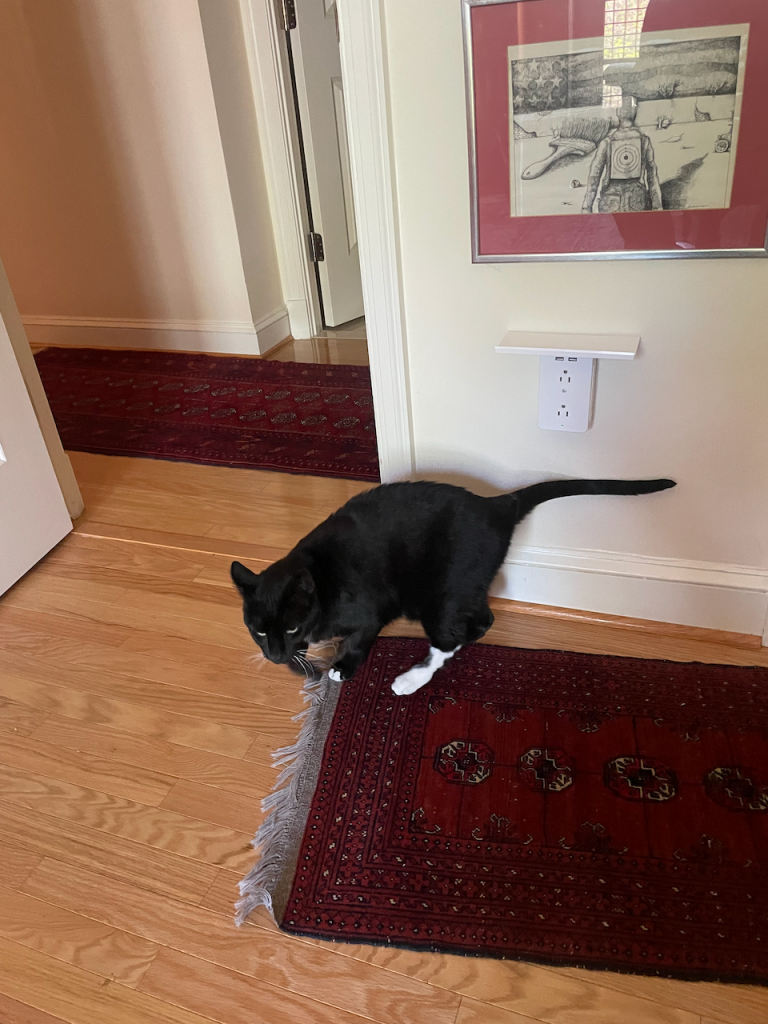
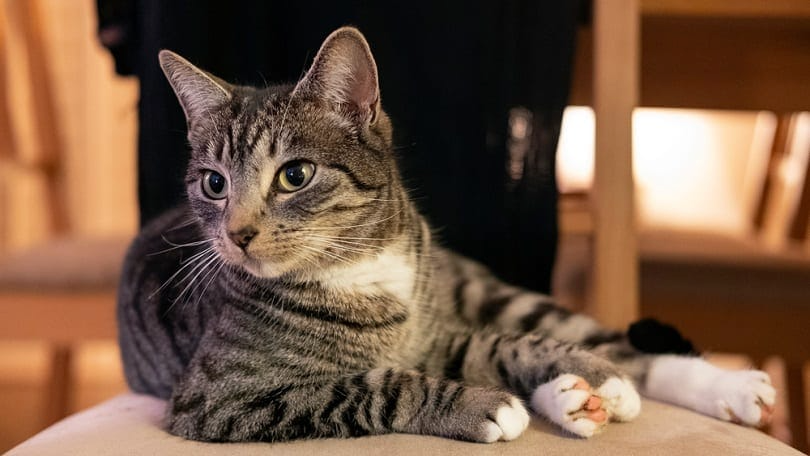
We had not been planning to adopt another cat due mainly to our traveling a lot, but my serious  traveling days are reaching their end; and Embry and I had been thinking it might be nice to adopt for the last time one more feline creature. This week a notice came out that an elderly lady living in our apartment house had died who had owned a cat that now had no home. The cat, “Oreo,” was five years old and described as a cuddly animal who loved people. We could not resist the temptation. His age seemed about right. We might even outlive him. We visited the apartment, met the owner’s daughter, who introduced us to a beautiful purring, black cat with white markings on his feet and neck. We took him to our apartment that afternoon. That was on Thursday. From Thursday to Sunday we did not see the cat. For three days we spent hours trying to find the little guy in our 1,700sf apartment. How could an animal find so many places to hide in such a small space? One spot was behind a bookcase and under our tv. Another was behind books in a small bookcase in my office. A third was in one of our closets. Once we discovered one of his hiding places he would move to another and then disappear again. But on Sunday, when Embry found him in a closet, he finally hopped down and was ready to be petted. The trauma of losing his owner and his familiar surroundings had been too much to take. It turns out that cats (and many other mammals) have emotions just like us humans.

So here we go again with Oreo, certainly our last creature.

Visit me on Substack!
Subscribe to my Substack!

Reflections of a Weary Traveler

As I look back on my 81 years of life on this wonderous planet, I can’t help putting my travel experiences near the top of the list of what I am most thankful for. The last three experiences which happened over the past two years —bad case of covid on a cruise to Iceland and Norway in 2022, cancelled flights to the BVIs over the Christmas holidays this year, and barely making it to Costa Rica last week– suggest that perhaps these adventures may be nearing an end, but still—how fortunate I have been! I have to give Embry a lot of credit. She has been the driver behind the quest to travel. By last count, together we have visited some 70 countries, several multiple times, and Embry on her own has added another ten to her list (mainly African countries and recently the “Stans.”). I have taken the lead on bareboat, sailing adventures (Tahiti, the Adriatic, the Mediterranean, the San Juan Islands, and over 20 bareboat cruises in the Caribbean), but almost all the others have been Embry’s doing. Let’s hear it for the Iron Lady!

Which ones stand out the most? The answer to that question for me is easy. In first place is our 2015 adventure around the world without flying. You may have followed my blog posts on this. Second would be our 1992 adventure in Russia organized by our son, Andrew, who was living there at the time, when with both our children and about dozen of our good friends, we took the Trans-Siberian Railroad from Moscow to a tiny village on Lake Baikal and explored the wild and lonely Taiga Forest. The third would be for me (Embry still gives me a hard time about not being invited.), when I was part of a three-week US delegation to China in 1986 to confer with local officials in about a half dozen cities about the Chinese housing crisis. And every trip Embry and I have had has been a learning experience. Not a single one has been a loser, even though I have had to deal with physical “meltdowns” on several of them.

But here is what I do not understand: Why is it that countries are friends one day and mortal enemies the next and then in many cases friends again? What is this all about?

There are many examples. Take Japan. In 1962 my college roommate and I drove across the country to Seattle where we boarded a Pan Am flight to Tokyo to join a group of American and Japanese college students working that summer on a farm at the base of Mount Yatsu, Japan’s second tallest mountain. This was only 16 years after World War II! Yet the Japanese students could not have been nicer or more welcoming. At the end of the summer, I spent a week with a Japanese friend, who invited me to stay at his family’s apartment in Tokyo. As I entered the vestibule to his family’s apartment, there was a painting of his father in uniform, sword drawn, walking in front of several British generals all carrying white flags. He had been a general in the Japanese Army during the war and the first commanding officer of the Japanese post war, “Peace Army.” His whole family welcomed me as part of their family. I still have a large, framed photo in our apartment of Mt Fuji, which his father had taken and autographed and given to me as a “goodwill gift.”

Embry and I have visited Russia twice–once in 1992 on the trip to Siberia and again in 2015 on our trip around the world. Both times we were greeted warmly everywhere we went. Andrew made many Russian friends when he lived there. On our first visit, Gorbachev had just been forced out, but the United States was still viewed as a friend and ally, and there was so much hope for the country and for democracy and so much good will toward Americans. And now?

China is another example. In 1986 the housing delegation I was on was wined and dined by local officials everywhere we went. They viewed the U.S. as a model for housing policy and treated us like royalty. In that year, the country was just starting to open up, having gone through the Cultural Revolution without constructing much new housing. When asked what they should do, we told them to build more housing. When Embry and I returned in 2015 for a month of travel there on our trip around the world, new apartment houses were everywhere. They had constructed several million new units and very proud of their accomplishments—as indeed they should be. In that year Americans were treated as friends. And now?

And Cambodia and Vietnam. Enemies in the 1970s and friends today. We were welcomed everywhere we went when we visited both countries in the early 2000s with no mention of the “unpleasantries” that had happened just twenty-five plus years before.

The answer, of course, is that this is just the way it is. Get over it: bad leaders, and we humans are herd animals. Accept human nature for what it is.

Yeah, but…

China and Russia have nuclear weapons. So do a lot of other hostile countries. Iran will soon have them. What are the chances that these weapons will never be used, ever? What are the chances that a mistake or miscalculation will never occur, ever? What are the chances that none of these countries will ever have an irresponsible, nutcase dictator, who is willing to take unthinkable actions because he thinks he can get away with it?

And on top of all this, we have climate change threatening to transform the planet.

One takeaway from our world travels is that we live on a beautiful planet. What is scary is that it is far from certain that we will be able to keep it that way.


Visit me on Substack!
Subscribe to my Substack!

Costa Rica: The Experience, Part Two

So why were we headed to Guanacaste anyway? It was a long way from San Jose, about 120 miles, not considered a tourist destination, and very remote. When I asked Embry this question, she answered, “That is exactly why we are going. That is what I was looking for.”

Good enough answer for me. The initial part of the ride out of San Jose was surprisingly stress free. The road was six lanes most of the way and built to interstate standards with the dreaded ditches safely placed on the far side of the shoulder. There was lots of traffic, but the motorcycles, cars and trucks zoomed along with only a few backups. We were headed  toward the Pan American Highway, called CR 1 in Costa Rica. This highway—or, more accurately, a network of connected roads—connects the northernmost part of Alaska with the southernmost part of South America. It is the longest continuous road network in the world covering 19,000 miles with only one small stretch of about 70 miles (the infamous “Darien Gap” between Columbia and Panama) where there is a break.

As we passed over one mountain range and then another and headed down toward the Pacific Ocean, the road narrowed, and we passed, of all things, a container storage area used by containerships, though standing alone on the side of a mountain and not apparently close to the ocean. Moments later the Pacific came into view, and we saw signs directing us to CR-1. We had made it through the first leg and would be headed north to Guanacaste for another 50 or 60 miles before we reached our destination.

What I did not expect, however, is that the mighty Pan-American Highway in this part of Costa Rica would turn out to be a two-lane road with dreaded drainage ditches replacing the shoulders—or worse, steep drop offs, or being dangerously close to unprotected construction sites where road rebuilding was starting to happen. It was a nightmare. When we managed to squeeze our way onto what was more like a parking lot than a road, we realized it was going to be a long slog to our hotel in Guanacaste. The initial GPS estimate was three hours from our hotel in San Jose. The actual time ended up being closer to five hours.

The benefit of slogging it out on a decrepit, jammed two-lane highway was that as we crept along, we were able to pass through village after village and get a feel for Costa Rican life in the countryside. When the new freeway is completed years from now, all these villages will be gone or relocated. Had we been on a new freeway, we would have missed all of this. For the most part the homes were quite modest, some constructed out of tin, cardboard, and discarded building materials, and a reminder that poverty still prevails in this “most progressive” of all the Central American countries. It also occurred to me that if some alien happened to land in Costa Rica instead of Washington DC, it would be a more accurate representation of how human beings live on the planet Earth. There are about eight billion of us humans now living on this small and obscure planet but at most no more than a couple of billion live in so called “advanced” or “developed” countries, even fewer in nice homes and neighborhoods. Within Washington, neighborhoods vary enormously, and we have our own nagging problems of poverty and inequality. My guess is that if the alien traveler stayed for very long, he or she would report back that the troubled planet had better get its act together pretty soon or it might not be worth a visit.

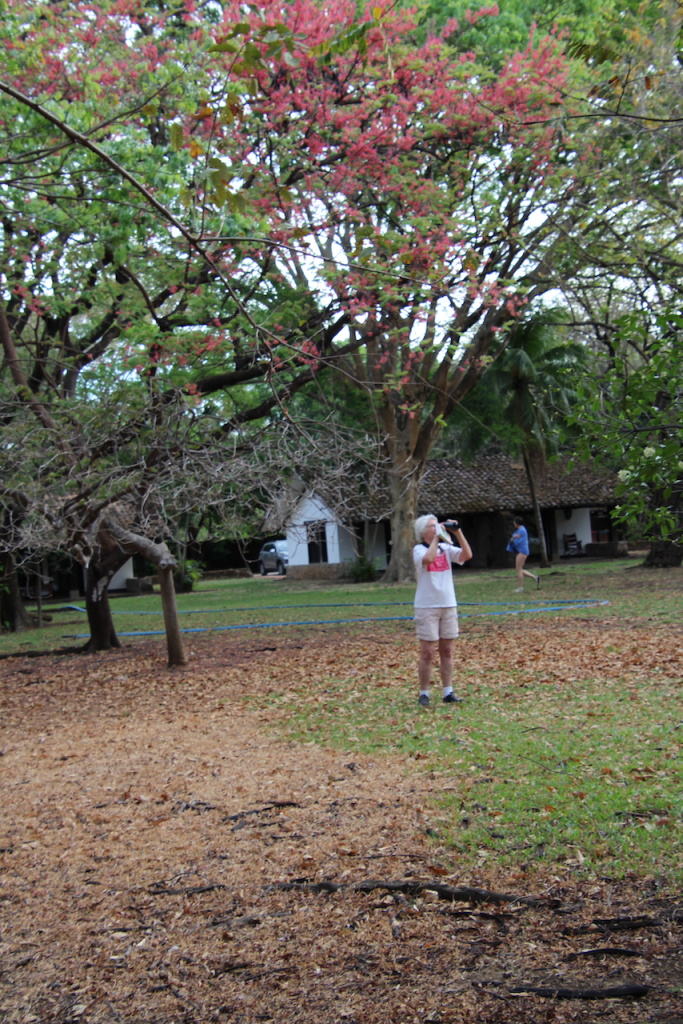
Embry had wanted to come to an area where you would not find many tourists. Guanacaste did not disappoint. We did not hear anyone speaking English among themselves and only saw a handful of others who appeared to be tourists. The resort that Embry had chosen was about five miles from the nearest village. The “Hacienda de la Pacifica” was a gated community and former ranch of several hundred acres on which were constructed about 25 cottages situated at the edge of a lush, ancient forest surrounding a meticulously groomed open area with a beautiful lap pool.  A small lodge and dining area were only a few minutes’ walk from our front porch. Our one-bedroom cottage had a living and dining area and full kitchen and must have been almost 1,000 square feet. You could rock on the front porch and watch the sun rise and set and enjoy watching extraordinary wildlife only yards away—exotic birds, cute little creatures that looked a little like large, fat squirrels without tails, deer everywhere, and occasional visits from families of monkeys. It was just what the doctor ordered. At best the resort was only about a third full with only a few tables occupied at dinner or breakfast besides ours. It felt like we had the whole place to ourselves.

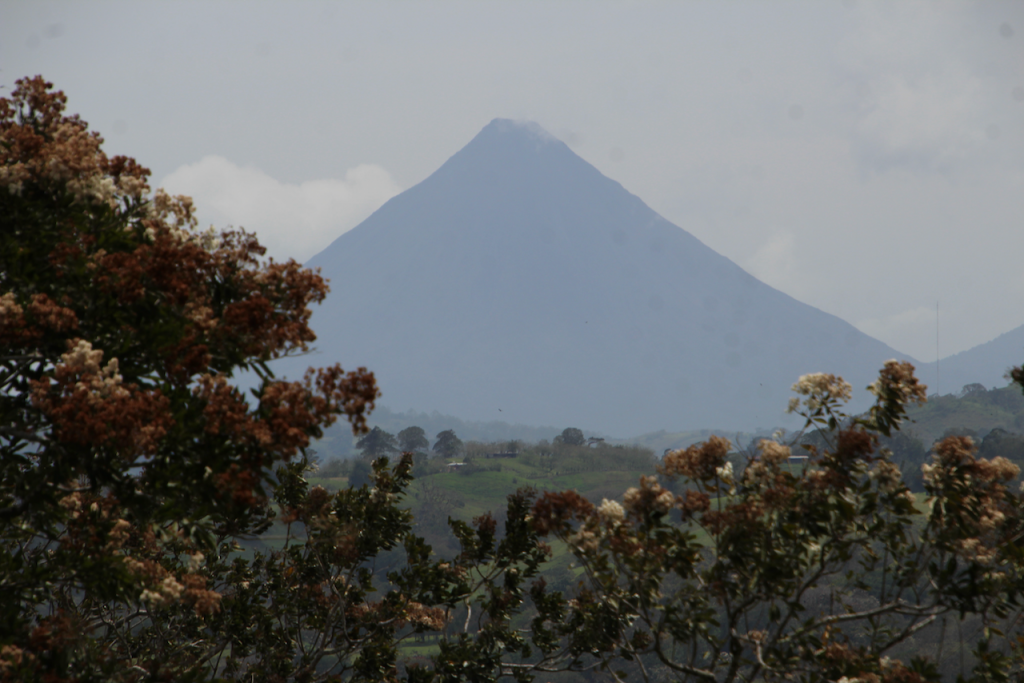
We took two all-day excursions. On the first day we drove on a two-lane highway about 50 miles up the mountain toward the east where I read in the guidebook that you could have views of the most famous volcano in the country, Arenal Volcano, and the largest lake, Arenal Lake. On the second day we drove about 40 miles west to a national park bordering the Pacific, Santa Rosa National Park. Both excursions were spectacular but very different. The drive up the mountains took us through arid foothills, an area similar to the California coastal area; and then as we approached the summit, we found ourselves in a tropical rain forest before the narrow road started down again. The views of the volcano and the lake were spectacular and worth the nail biting and at times terrifying experience of trying to dodge a bus or truck on a hairpin switchback without going off a cliff or into a drainage ditch. When we got too close to a ditch, Embry would warn, “Ditch, ditch!” and I would grit my teeth and try to edge the car a few inches more toward the middle.

The second excursion took us to an isolated “dry forest” where it heavily rains most days from late May through September and then no rain at all from October through early May. Since we were visiting toward the end of the dry season, few trees had any leaves, and the creek beds were bone try. We were told that by  July, the forest would resemble a tropical jungle with the bone-dry creeks raging and flooding the narrow walking paths. When we arrived at the national park, there was only one car parked in the parking area, which could accommodate no more than about a dozen cars, and that belonged to the forest ranger. Only one other car showed up while we were there. If Embry did not want to go where we would find a bunch of gawking U.S. tourists (like us), she surely found it.

So that was about it—a short and sweet visit but not nearly long enough to see the extraordinary diversity and natural beauty of this tiny country. You really need at least two weeks for that. Two weeks of driving, however, would have been more than I could have handled. But what we did see and experience gave us a taste and enabled us to understand why there is so much enthusiasm about the beauty and diversity of Costa Rica.

I wish I could say the drive back to San Jose was uneventful, but, alas, we witnessed four crashes on the northbound lanes on our way driving south on the Pan American Highway with traffic backed up for miles and ambulances hemmed in and not able to get to the those injured. While traffic was moving fairly quickly on our side going south, the “Waze lady” on our GPS came on and directed us about halfway into the drive to get off the Pan-American and take a small, two-lane road over the two mountain ranges. This proved to be yet another harrowing experience with numerous steep switch backs but thankfully not a lot of traffic—and, of course, spectacular views. It also took us almost six hours to reach the hotel near the airport where we would depart the next morning. When we dropped off our car at the Avis agency, I raised my arms again and exclaimed, “Victory, we did it!” The ordeal getting here turned out to be worth the effort. My intuition tells me that this trip probably marks the end of my “adventure travel,” (Embry is taking our two granddaughters to Europe for three weeks this summer with Jessica helping.), but what a ride this has been! Stay tuned for some final reflections on our travel experience in the next blog post.


Visit me on Substack!
Subscribe to my Substack!

Costa Rica: The Experience, Part One

On the long flight to San Jose from Orlando, I started to thumb through a Costa Rican guidebook, which a friend had let us borrow. I realized that we were headed to an extraordinary country. Why had it taken this long to begin the research? Why wasn’t I paying attention? A country only the size of West Virginia with a  population of around 5 million and one of the world’s natural wonders: 11 volcanoes , several still active, two mountain ranges with many peaks towering above 11,000 feet, rain forests, desert-like “dry forests,” coffee and banana plantations, exotic birds and wildlife, waterfalls, raging streams with kayaking and rafting, the windsurfing capital of the planet, the Pacific Ocean on one side and the Caribbean on the other….The list was long. Tourism attracts over three million visitors a year, and resorts are plentiful. Costa Rica is the most stable Central American country and its only functioning democracy, one of the few countries in the world without a standing army, and the center for eco-tourism. Good heavens! Why hadn’t this country been at the top of our bucket list?

I did also note that in the section giving advice to tourists that there was a soft heads-up on renting a car, suggesting that it might be advisable to get your hotel or resort to pick you up or to hire a driver due to the poor condition of the roads and the high accident rate. I did not think much about that at the time since I like to drive and consider myself a good driver. Embry had casually mentioned that she had left her driver’s license at home, but I was usually the driver anyway, so no problem. I was finally getting charged up and ready to go.

As we deplaned in San Jose, the nation’s capital, we entered a large room, teeming with humanity. We got in the short line reserved for families and seniors to clear passport control. Embry breezed through. I was stopped because of my “invalid passport.” Oh, my goodness, I thought, here we go again! The agent excused herself and returned a few minutes later and stamped the passport without commenting, and out we went as I raised my arms in a victory salute. We spotted our bags immediately and headed to the Avis pickup spot, picked up our car and were on our way.

First stop, our hotel in San Jose, a small hotel in downtown San Jose with a quaint French name.

As we made a right turn into a very congested, narrow two-lane road, Embry suddenly warned, “Watch out, Joe, there is a deep ditch on the right and you almost went into it!”

“Yes,” I answered, “But the bus passing in the other lane missed us by inches and I had to get out of its way. Why is there no shoulder!”

Welcome to Costa Rica—and the ubiquitous ditches, which would become over the next five days the bane of my existence!

Not every road in Costa Rica has these two-to-four-foot, paved ditches, in the shape of a “V,” but a whole bunch do; and they are terrifying if the road is narrow and two-lane and has no shoulder. One false move and you end up stuck in the ditch or worse—your car flips over. The reason for the ditches somebody told me was to allow water to drain easily from roads during the rainy season, which is basically from May through September.  I announced to Embry that if we both got home in one piece, I would call the trip a huge success regardless of what else happened on the trip.

We soon came to an intersection with a major six lane, interstate-like artery that went into the central part of the city. The traffic of cars, buses, and 18-wheelers leading into the city was bumper-to-bumper inching along. We wriggled our way into the third lane as a motorcyclist whizzed between our car and the car in the adjacent lane, passing us on the driver’s side with less than six inches to spare. Then another on the passenger’s side, and another and another. These motorcycles were everywhere darting between cars, going in and out and dodging in front of cars and massive trucks and busses when there was an opening. I had never seen anything quite like it, but had to admit, compared to the cars and trucks, they were making good time.

San Jose is situated in a valley almost a mile high and surrounded by peaks almost twice as high. During the dry season the high temperatures are in the high 70s in what could be described as a delightful climate. Just under 400,000 people live in the country’s largest city though it seems larger given the traffic and congestion. Except for a colonial church or two, a few squares and older government buildings, there is not a lot in the way of tourist attractions.

After a little over an hour, we finally had made the 20-mile trip to the city center and got off the “freeway” to a main street, following the instructions on the GPS. The main street was even more crowded, not just with cars, trucks, and buses, horns blasting, and motorbikes dodging in and out but also with pedestrians, shoulder to shoulder on jammed sidewalks and jay walking between stalled cars waiting for traffic to clear. The other thing that stood out were all the security iron bars, fences and barbed wire around the stores, houses, and apartments.  In our travels and Embry’s work, we have been in tough neighborhoods all over the world—the notorious barrios outside of Lima, “informal settlements” in several African countries, the famous favellas in Rio. This was nothing new to us, but the initial impression of this extraordinary country was a far cry from the “Garden of Eden” described in the guidebooks. It felt like a “Third World,” developing nation to us.

The chaos, jammed streets and pollution in San Jose, is why most tourists skip it if they can and are whisked away in limousines provided by fancy hotels and resorts in the mountains or on the coasts. Yet to miss this frantic city would be missing something very important about the country and about how a whole lot of people in the world live. Over the years this part of our travels has been what I have valued the most—not so much seeing the tourist attractions but the way that ordinary people live.

The challenge, of course, was finding the hotel, which we did in another half hour thanks to the GPS. Since few streets in San Jose are even marked with street signs, you have to wonder how any tourist could have found an obscure hotel before we had the mapping technology. By this time, however, I was a wreck. It was now getting toward five in the afternoon Costa Rican time.  We had been up since four in the morning their time, had endured enough stress at National Airport to trigger a psychological melt down, and now had been on the road for almost two hours dodging motorcycles and pedestrians, 18-wheelers, trying to avoid ditches and wind our way through packed streets to find a place to sleep.

The hotel was located on a quiet side street about half a block from the bustling main drag. I found a temporary parking spot and waited for Embry to check us in. The hotel had two levels, seemed quite small to me, and was protected by two huge iron gates, which I noticed were padlocked. No one seemed to be present, and it appeared impossible for us to get in. In about 10 minutes Embry appeared smiling.

“Well, all the doors are padlocked, but I finally found a young guy working on the grounds who did not speak a word of English. We communicated via Google Translate on our smart phones. I do not know how Google translated into Spanish my question of where someone might be who could let us into the hotel, but his answer to my question came back to me as “He is in a corner and we don’t know where he is.”

In a few minutes, however, an older guy did emerge from the locked gate, opened a second padlocked gate where he motioned for me to park my car, and proceeded to check us in. It appeared we were the hotel’s only customers. We were set and at last could catch our breath. The hotel was charming in an old world, tarnished sort of way and just fine for us. We wandered up to the main drag looking for a restaurant but could not find one, so we ordered tacos from a tiny takeout with two small wooden tables, went across the street to a liquor store and bought two bottles of beer, and returned to sit at the vacant table, eat our tacos and watch the hustle and bustle of San Jose and the “Ticos” (what Costa Ricans call themselves) passing by. When we returned to our hotel, a small bus was unloading a dozen or so serious hikers with huge backpacks, all appearing to be in their twenties. We crashed around nine, ready for the adventure the next day, which would take us over two mountain ranges to the wild and lonely Guanacaste Region in the upper northwest corner of the country about 120 miles from San Jose.

Stay tuned. Challenges awaited us.


Visit me on Substack!
Subscribe to my Substack!

Adventure Travels With “The Iron Lady”: Getting to Costa Rica (Barely)

“Iron Lady” is a term of endearment used to describe Margaret Thatcher, the first female prime minister of the United Kingdom from 1979-1990, who was known for her toughness and perseverance, often against great odds, not losing her cool, and a person admired both by friend and foe. While Embry is very different from Thatcher in many ways, the following story will allow you to understand why she too is an “Iron Lady.”

This post and the one which follows is about our recent trip to Costa Rica. The only reason we were going to Costa Rico was because we cancelled a flight on Jet Blue last summer, as a result of our cruise line cancelling the cruise due to Covid.  Jet Blue gave us a credit for the tickets. The tickets had to be to a foreign country and had to be used within a short time period, which was about to expire. There were only three foreign countries that Jet Blue flew to that we were interested in—Bermuda, Cuba and Costa Rica. We chose Bermuda only to be informed that Jet Blue no longer flies to that country. Then we chose Cuba, which the Jet Blue agent strongly advised against for reasons she did not fully explain, and happily ended up with Costa Rica. We knew very little about the country, and due to the short time frame for using the free ticket, Embry had not done her usual research ahead of time—arbitrarily choosing two hotels, one for the first evening in San Jose, the capital of the country, and for the rest of the week, a “resort hotel” in the northwestern Pacific coastal area called “Guanacaste,” the most remote region in the country. The final ahead-of-time piece was to reserve a rental a car. That was about it. We were looking forward to being surprised.

How important was this trip? Well, very. I will turn 81 on April Fool’s Day and am starting to feel my age. Embry is four years behind, but we both know that our traveling days are nearing an end, at least our adventure traveling days—heading off to a new and mysterious destination without the benefit of being on a guided tour. This could be our last shot. In fact, this was the reason I had set the alarm clock to ring just after five in the morning so that we could be certain to make the flight, which was scheduled to depart from National Airport at 7:38 A.M. I did not want to miss this one.

There was no problem getting to the airport by cab. We arrived at 6:15 giving us almost an hour and a half before the gate would close. I was relaxed and confident as we approached the international desk of Jet Blue where there was no line. A smiling, uniformed gentleman in his forties with a funny name and what sounded to me like an Eastern European accent welcomed us. I could almost taste the coffee and fresh croissant that I planned to have at the coffee shop area near the gate where we would be waiting to board the plane.

He looked at Embry’s passport and smiled and then took mine and paused.
“I am sorry,” he replied, “but you will not be able to board the plane. Your passport is invalid.”

Neither of us said a word and looked at each other in stunned disbelief.

“What do you mean it is invalid?” I demanded, “It was fine to get us into the BVIs two months ago.”

“You are not going to the BVIs. You are going to Costa Rica. This is their rule. Your passport expires on March 25. Today is March 6. That is not enough time. You must have at least 90 days on your passport past the time you enter the country, or you are not allowed in. You have less than three weeks left on your passport. That is not enough.”

When situations like this happen, I automatically morph into my outrage act. I did not shout but came close to it, frantically gesturing with my arms, and asked what the point is of an expiration date if the passport becomes invalid three months before the official expiration date. I went on to add that the policy was wrong, stupid, ridiculous, made no sense, outrageous, and dumb and that he must not understand the regulations and should call his supervisor.

(I have since learned that many countries have such policies, and some require as much as a six month cushion.)

The poor guy looked embarrassed and said that he was sorry, but there was nothing he could do about it. It was the policy of the U.S. State Department. If he did not follow the proper procedures, he could lose his job.  Embry commented calmly that what counted was the policy of the Costa Rican government and that we had heard nothing from the U.S. Embassy in Costa Rica about the 90-day requirement. He excused himself for a few minutes and returned with a printout of what appeared to an official notice from the U.S. State Department showing that the 90-day rule applied to Costa Rica. The only option would be for me to get a new passport and then apply the credit to  the next flight, but since that needed to happen within a few weeks before the free ticket expired, it was unlikely to work out. He then proceeded to go over all the other options, including  rebooking to Costa Rica several months from now, the cheapest flight being about $1,500 person and involving overnight layovers. He then tried to come up with flying to U.S. locations like Houston or Orlando or New York or Chicago, or Puerto Rico– some “fun place” that we could have an enjoyable location.  

The time that it took for what I will call “the  encounter” was over 45 minutes. He suggested one option, then another, then another. All would cost us several thousand dollars, and none made any sense. He was empathetic and obviously trying to do the best he could, but the situation was hopeless. When customers behind us complained, they were reassigned to other lines. During the middle part of the encounter, Embry said few words and then mysteriously disappeared. I was left staring at the befuddled agent, who was desperately trying to find some way to satisfy us and get me out of his way so he could assist other customers.

I reverted from my outrage mode to my despair mode. I realized that our chances of getting to Costa Rica, possibly our last opportunity for adventure travel, were close to nil. I glumly stared at the floor.

At 7:00 A.M. Embry reappeared and gently thrust her cell phone toward the weary agent.

“Look at this,” she said softly but firmly.  “This is from the Costa Rican Embassy website in Washington, D.C.  It says that you have to have at least one day remaining on your passport before your scheduled departure, not 90 days. Please confer with your supervisor.”

“Well,” he replied, “What you have says one thing, and the instructions I am following say something else. I must follow my instructions, or I will lose my job.”

“I understand,” she said, “but could you please consult your supervisor?” Her tone was polite but firm, and she had a slight smile and seemed more relaxed. He gave her a puzzled look, reread what was on her cellphone and the official policy on his printout, shrugged his shoulders, started looking at his computer screen again, and picked up a phone. I presumed he was calling his supervisor.

We glanced at each other with hopeful looks.

I then noticed the time. It was now 7:15. We had exactly 23 minutes to make it to the gate for a 7:38 departure. Still no decision.

Embry placed her bag on the scale and motioned for him to tag it, warning that we were going to miss our flight if he did not act immediately. He put down the phone, had a concerned look on his face, and began to fumble with the with tags. He motioned for help from an assistant and the bags went onto the belt. I do not recall that he said one word to us.

Yes!  We were   going to Costa Rica after all. Victory!

We thanked him as we bolted toward the security check-in area. He managed a faint smile and waived back.  Then it occurred to me: What would be the chances of anyone getting through security in a very crowded airport in less than 20 minutes? Our bags would happily be on their way to Costa Rica. We wouldn’t. 

We charged toward the escalator, reached the bottom, turned the corner, and then stared at a line for security clearance that was so long it spilled out into the vast lobby area. In fact, I had never seen a line at National Airport this long. I remembered there was another security check-point area which was more remote but often had shorter lines, and we charged toward that with Embry leading the way with me hobbling along as best as I could with two bad knees. The clock was ticking. The second line was even longer, at least 150 people, probably more. The wait had to be at least 20 minutes, probably more like 30. I did not look at my watch, but I knew it had to be close to 7:30.

We looked at each other. “No choice,” I said, “Let’s go for it!”

Embry ducked under the first rope and barged in ahead of an astonished ticket holder, who had probably been waiting for several minutes.

 “Sorry, excuse us,” she said, “Old folks trying to make a flight.”

Before the person had a chance to object, Embry had ducked under the second rope, saying the same thing to another surprised passenger. I followed, ducking under the ropes, saying “elderly emergency, elderly emergency!” In all we ducked under five ropes in a minute or two, receiving puzzled looks and occasional smiles. There was not a single protest or a “what the hell do you think you are doing?” One guy cheered us on, “Go for it, guys, you can do it!” Another asked me how much time we had. I looked at my watch and said, “eight minutes before the doors close,” to which he answered, “No way.”

By the time we reached the head of the line, the word was out, and the people who were in the process of getting their IDs checked moved aside and let us get ahead of them. The officer quickly screened our passports, checked our boarding passes with a skeptical look, and sent us to the shortest line for the carryon check. The personal screening went quickly. When the bags came out on the conveyor belt, I checked my watch. It was 7:35—three minutes to make it.

Embry charged off. I hobbled behind her encouraging her to run as fast as possible and get them to keep the doors open for me, then yelled, “What number is the gate anyway? She hollered back, “Gate C-22.”

As I stumbled into the C gate area and scanned to see where Gate-22 was, all I could find were Gates 23 and higher. Gate C-22 must be in some other location. What do to? Doomed again.

Suddenly, Embry appeared panting, “I made it just before the doors closed, and they are holding the plane for us. By the way, there is no C-22. What I meant was C-24. Hurry, hurry!”

We stumbled into a fully packed plane with only two seats remaining. The doors closed behind me. We were off to our adventure in Costa Rica. The Iron Lady had come through again. The actual takeoff was delayed a few minutes to allow for late baggage to be loaded (our bags for sure) and we landed on time in San Jose around 3:00 P.M. after a three-hour layover in Orlando.

Now is there any doubt in anyone’s mind why this could well be our last adventure travel where we try to do it all on our own?  We are too old for this. But wait! You do not know what was awaiting us when we finally arrived in San Jose, Costa Rica. That will be the subject of the next blog post.


Visit me on Substack!
Subscribe to my Substack!

On Facing Deafness

Many who know me are aware that I have hearing issues. I have had a serious hearing problem since the mid 1990s. I got my first hearing aid in 1997 and am now on my fourth of fifth pair. Each pair seems to perform a little better. Let’s hear it for medical technology! I get by, but only with the help from these miraculous inventions. What would have been the situation 50 years ago?

 But this week I was confronted with not being able to hear very much—even with my hearing aids on. Over the past several weeks it seemed I was starting to lose the ability to figure out what people were saying, and for the last three of four days, understanding more than a word or two had become a real challenge. It was not just the weak sound level. The greater challenge was to understand the words. I could hear the sounds, but they were muddled so that it was hard to pick up a word.

What was happening?

In desperation, I tried to get an appointment with my audiologist at Kaiser Permanente, my health care provider. Kaiser has a lot of strengths but getting audiology appointments is not one of them. On one occasion a couple of years ago, I was told I would have to wait six months to see an audiologist to fix what I was sure was a routine problem of cleaning the hearing aid. Kaiser basically said, your problem, not ours. The next day I informed them on their website that I was filing a claim of Medicare fraud and abuse with the federal government, which led to an appointment at 8:00 am the next day with a pissed off audiologist at another Kaiser location. After she fixed the hearing aid in about three minutes, she warned me, please, never, never do this again! (The threat of a Medicare fraud claim  to the federal government  always seems to get a response, often on the same day.)

This time the problem with my hearing was different. For the past week or so I had had increasing difficulties understanding what people were saying. Countless zoom meetings with the nonprofit boards I serve on were the biggest challenge. I thought the problems might be due to my computer or my cell phone. I tried to make an appointment with my audiologist, who is very competent and very nice doctor, but who informed me that she was fully booked for the indefinite future, and I should try for another audiologist at another Kaiser location. She gave me a special number to call. I called the number and talked to an operator, who said that from what I told her I probably did not need an audiologist but should return to my assigned Kaiser office and get the audiology tech person to check the hearing aids, which I did. The audiology tech person said my hearing aids were working perfectly and that what I probably needed was a hearing exam, which of course would require one of the “unavailable audiologists” and take a long time to schedule. I replied that I suspected that my hearing difficulty might be caused by wax in my ears. I had already made an appointment with the ENT doctor, whom I visited the next day. When she removed a huge amount of wax in both ears, I thanked her, commenting that I believed that should fix it. I breathed a sigh of relief and was elated to be able to join the world of hearing again.

Problem solved.

Except it wasn’t. In fact, after the wax removal my hearing became worse, not better. At lunch with an old friend following the procedure, I had to struggle to understand what he was saying. Ditto for two zoom meetings and an in-person group meeting the next morning with a men’s group I belong to where I was the moderator. I tried to test several options—to see if I could hear any better on phone calls, to see if I could hear better listening to Pandora or the radio, and  to see if another zoom meeting worked better. I turned on the TV and tried to listen to the news. I could not understand a word. Nothing worked. My hearing aids had been determined to be fine, in “perfect condition” according to the audiology tech person. I had had the wax removed from my ears. There was only one conclusion: The problem was due to my failing hearing. I was becoming deaf, not hard of hearing, but deaf, really deaf.

This was an existential moment. Do you have any idea of what it is like not to understand what people are saying, not to be able to listen to music, or not to be able to go concerts or plays or movies without subtitles?

It is already embarrassing enough to have to ask people to repeat things all the time, but not being able to hear almost anything? A dire situation.

I attended a high school reunion last year where classmates and spouses chatted loudly in a crowded area resulting in enough ambient noise that made it extremely difficult to hear what people were saying.  I had to fake it that I understood the conversation and guess at what would be an appropriate response. After I received feedback from some puzzled classmates,  I surmised that a typical conversation with me probably went something like this:

“Hey, Bobby, great to see you! How is  your brother doing?

“Not good, Joe. He died a couple of weeks ago in an automobile accident.”

Pause to try to figure out what he said and then a guess, “Great news, Bobby, really glad to hear that.”

 I got a call after the event from a good friend who told me he had to assure several people that I was not suffering from severe dementia. Hearing loss is not for sissies. And now to have  hearing aids that are declared to be in perfect condition but which do not work?  Panic time!

I told Embry about my problem when I returned home from my lunch and asked her to say a few words. I struggled to understand what she was saying. I was becoming a deaf duck! And it happened so quickly. No wax in my ears, hearing aids fine. What else could cause this? How could I as a hopeless extravert, who thrives on conversation and give and take—how could I survive without being able to hear? And if you can’t hear, you can’t talk and make sense as evidenced at my high school reunion.

Then in my moment of despair, I had what I would call a brilliant, last ditch idea. I had a couple of old hearing aids about 10 years old. Why not try them and see what would happen?

I cannot overstate how important this moment was for me. If my inability to hear persisted, then I could only conclude that at my advanced age of (almost) 81, my hearing was gone. It would be hopeless. What kind of life would I have from this point on? How could I cope?

With my heart beating fast and my palms sweating, I unhooked the earpiece connections from the current devices and plugged them into the old hearing aids. Then I put the old hearing aids into my ears and held my breath.

All of a sudden I heard music coming from the radio, which I had not even been aware  was turned on. My goodness! They worked!

With the old hearing aids in place, hearing was back to what it used to be! Maybe even better. Eureka! So, despite the rosy diagnosis by the tech person, the hearing aids were the problem after all.  It is unclear what is a miracle or what is luck or what is just the way life is. But I will tell you this: It made me realize how important hearing is and the challenge that people face who are not able to hear. You do not hear many severely hearing-impaired persons complaining, but it is still a huge handicap. We humans do what we have to do to play the hand we have been dealt as best as we can. A lot of people have no choice but to tough it out. Many of us have handicaps that we plow through, but still…

My next task is to get a new pair of hearing aids that actually work. How hard could this be? At Kaiser the answer is harder than it should be. Fortunately, there are good audiologists in Washington that provide options.

 But most important, this experience underlines how fortunate we are who can hear (including those of us who require hearing aids) and how we take so much for granted.

Stressful moment but happy ending.


Visit me on Substack!
Subscribe to my Substack!