Life at Collington Continues: The Big Sailing Regatta 2025

There are many great things that happen at Collington. On average there is usually one big event each month where all residents—including those living in assisted living and memory care– are invited along with staff members who have been given the time off—to gather for an event or a party. There is usually good music and food, and the atmosphere is festive. Of all these events, however, the annual regatta is the biggest. At least that was what I had been told when I was on the Collington Board of Directors several years ago and when Embry and I had visited Collington before we decided to move here.

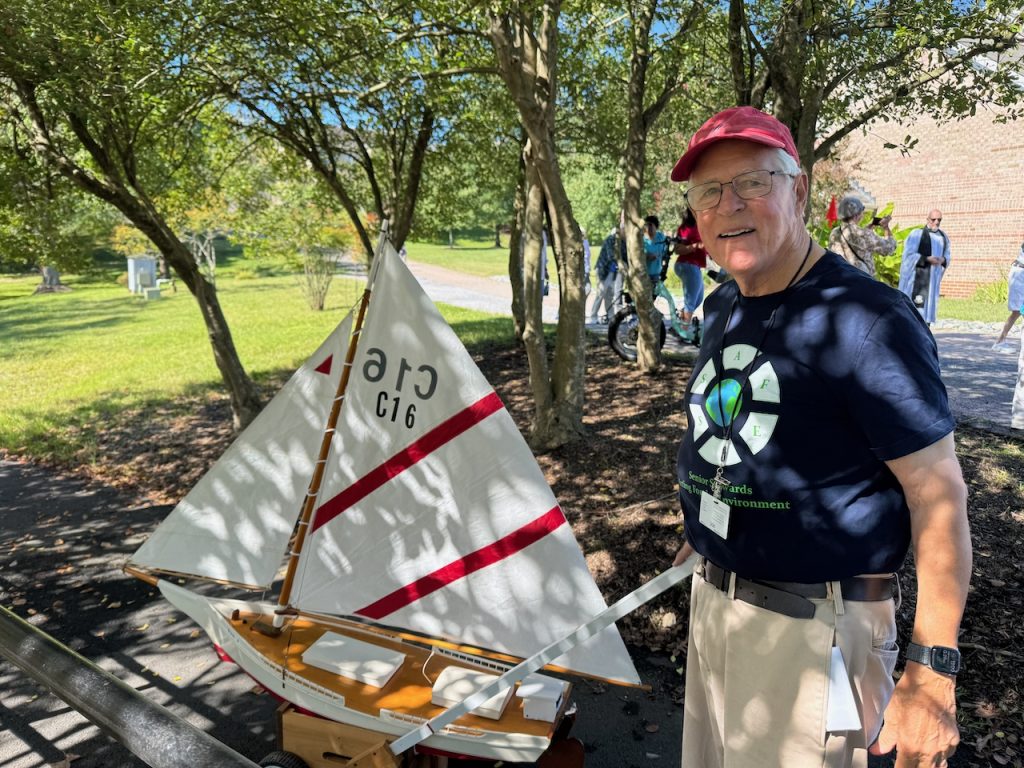
This year the annual regatta happened on Friday, September 12. Several weeks before I had noticed an announcement that practices for the regatta would begin on a Saturday and wandered down to Collington’s small lake to see what was going on. There were about a half dozen people gathered on a small pier standing beside a group of six identical sailboats that were modeled after Skipjacks, the famous oyster fishing boats on the Chesapeake Bay with wide beams, shallow drafts, and huge mainsails. These replicas were not all that small—three to four feet long—and weighed at least 25 pounds. Before I had a chance to say more than a greeting, someone handed me a remote control device and pointed to a boat just launched.

“That one is yours,” he said, “go for it.”

I looked at the remote control panel, which had only two keys—one that was labeled “in” and “out,” which controlled the main and the jib, and the other “left “and “right,” which controlled the rudder.

Now those readers who know me know that for practically all my adult life I have been an avid racing and cruising sailor and that sailing has been part of my identity. Embry and I have owned seven sailboats over a 46-year period starting in 1974 with a 16-foot, albeit beat up,  high performance racer with a trapeze (a “505”),  which sank in the Potomac River on the Fourth of July 1974, and ending with “Second Wind,” a 39-foot cruising/racing boat that had been part of the Sunsail charter fleet in the British Virgin Islands, which we sadly sold in 2023. I raced these various boats (my favorite racer was our J-30, “Carolina Blue”), mainly on Wednesday evenings during the sailing season, a tradition on the Bay for many yacht clubs. I once calculated that I had raced in something like over 800 races over the years. I was never a top racing sailor but can count over 25 sailing trophies or plaques that hang on the walls or are in bookcases in our small cottage at Collington.

So, you could conclude that I know what I am doing when it comes to sailboat racing. Well, not exactly. Controlling a model sailboat is a whole lot different from steering the rudder of a boat when you can feel the wind in your face, judge the waves, and feel the boat respond to every touch on the tiller or wheel. Some have described the experience of model sailboat racing more akin to playing a video game than actual boat racing, complicated by the fact that whatever breeze is affecting your boat is probably not the same wind that you feel hitting your face since you may be hundreds of yards away. In a word: It is a challenge.

The practices for the Collington Regatta happened every Saturday for five weeks. After each practice, I was mentally and physically exhausted, and it seemed to take forever before I could get the controls figured out. Also contributing to the exhaustion was the fluky nature of the wind on the small lake. Winds were light, unpredictable and always changing and shifting due I suppose to the barrier of tall trees surrounding most of the lake. My five competitors were all very nice people and had the same difficulties I did. While most had more experience than me sailing model boats, no one had anything close to my experience racing full-size sail boats. I should have had a big advantage.

But, alas, I soon realized I didn’t. I was very much aware that the regatta could be won by any of the six boats. As the date of the regatta got closer, I became more apprehensive, bordering on nervous. My identity as an experienced racing sailor was on the line. What if my boat plowed into the weeds (as had happened to some of my competitor’s boats and could easily happen to mine)? What if I came in last? In fact, on the last day of practice before the Big Regatta, I had come in last–or “DFL” as it is called by sailors– which I blamed on a weak battery in the control mechanism, but this was a reminder that it could very easily happen in the Big Race.

The name of my boat was “Eva J.” And at times she seemed to have a mind of her own, turning left when I thought that I was directing her to turn right and vice versa. That is why I am using the “we” pronoun to describe the regatta experience. Eva J  had her way of doing things. I had mine. When we worked together, we had the best results.

When the day of the regatta finally arrived, I was on pins and needles, which sounds especially odd given the number of regattas I had under my belt including participating in three national championships when Embry and I had trailered our beloved 16-foot Wayfarer (“Mother Courage”) to Lake Huron. But this was different. The regatta had so much hype and so many people would be watching. It was my chance to make a splash as a new resident, to gain some recognition and respect that I knew I richly deserved but so far was sadly lacking.

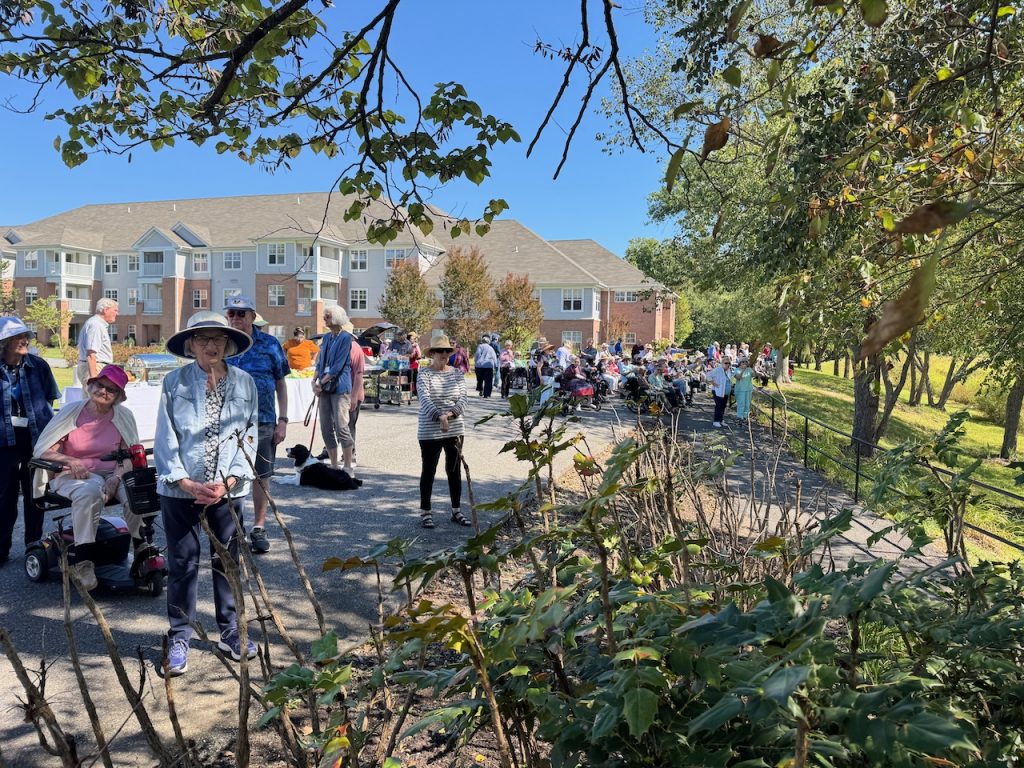
The six skippers hauled our boats along a hallway leading to the door opening to the path to the lake and stood in line, waiting for our name to be called. An Episcopal clergyman was standing at the door in full clerical garb prepared to give his blessing of the fleet. Others were gathered around the door to observe the beginning of the ritual. One by one, as the door was opened and the name of the boat and the skipper was announced, each of us paraded our boat on its carrying device in front of the crowd of several hundred applauding old folks and staff, some in wheelchairs. Several rows of chairs had been set up and grills were burning, as the dining staff cooked hot dogs and hamburgers and gave out sodas and water, popcorn and popsicles. Sea shanties were blasting over the loudspeakers. Of all the regattas and races that I have participated in over the years, none hold a candle to the atmosphere of the Collington Regatta.

The written announcement promoting the event stated “betting begins at 10:30, the race at 11:00.” Most of the crowd had probably already placed money on their favorite boat. As a new resident, I doubted that neither Eva J nor I had received many bets. Nor do I not recall hearing many cheers for us as we headed for the water.

In addition to all the regalia, the weather was drop-dead gorgeous. Temperatures were in the mid 70s, the sky was Carolina blue with occasional white cloud puffs, and best of all, there was a gentle but consistent breeze. During the five previous weeks of practice, we had never had a breeze this good. How lucky could we be? But still. The race had not yet begun. Not one of us anxious skippers knew how it would turn out. My heart was pounding fast.

The Episcopal priest blessed the fleet, and one by one, each boat was eased into the water as the crowd applauded. We skippers were all feverishly fumbling around with our electronic devices to be sure they were working. The countdown began as we all tried to get into position for the start, then the sound of the horn. Off we went!

One of our neighbors who lived in our cottage cluster announced the race to the crowd over a loudspeaker. Bets were on the line. People were cheering.

The racecourse was probably less than half a mile long and had three rounding marks plus a start/finish line, and the regatta involved racing the boats around the course twice.

Now after five weeks of practice I had figured out that the main factor determining success in this race would be to get “clean air,”—in other words to maneuver the boat into a position where Eva J got better wind than any other boat, not all that different from sailing real boats.  But easier said than done. Yet with a little luck I was able to position Eva J just enough ahead of the others so that she got the better breeze and she headed toward the first mark, up wind, but not so much as to require tacking, and we rounded a good 10 boat lengths ahead of the others, which were bunched together trying to find the breeze. We were able to expand our lead as Eva J zoomed off the wind on a broad reach to the next mark and then downwind to next mark and back up wind to the starting line for the second and final lap around the course. Euphoria! I was nailing it.  We even passed one boat which was struggling to make it to the first mark. None of our competitors were even close. At last, I could start to relax.

Then came my first mistake. With the sun in my eyes on the second time around the course I had trouble finding the second mark, which followed the long downwind, easy leg; and when I finally spotted it, I realized that I had passed it minutes before. I had to make a sharp turn into the wind and tack to get back on course, which cost Eva J and me about five minutes as the boats behind us now were now all charging downwind toward the mark. When I finally got back on track, our lead had been cut well in half. I could not afford another mistake and breathed a long sigh when I realized that we were broadening our lead again. Eva J rounded the last downwind leg, and we headed up wind to the finish line only about a hundred yards away. There was no way that we could lose.

That is, until the crash.

As the boats following us sailed downwind toward the mark that Eva J had rounded several minutes before, one of the boats that had not yet passed the last mark took an unusual course that blocked the course that Eva J. and I were taking to the finish line. It caught me totally by surprise. I did not see the boat and was not expecting it. Bang! We crashed. I could not believe it. Here I was headed to victory, and suddenly, out of the blue, this happens. Just my luck. I am certain Eva J was on a starboard tack, which gave us right-of-way, but that was irrelevant because in model boat racing at Collington that did not make any difference. The only rule was to avert a crash at all costs. I groaned as I realized the sails of the two boats had become intertwined, and the two boats were stuck together being pushed by the wind back to the mark that Eva J had just rounded. The other boats were now catching up fast.

I fiddled with the electronic device feverishly moving the tiller back and forth to try to free us up and finally it worked. The boats separated and Eva J was able to point upwind again in the direction of the finish line. But it took some time—at least two or three minutes, which was enough time for two boats to pass us.

Doomed.

I tried to regain my composure and was comforted by the fact that I knew Eva J had faster boat speed than the other boats. We also had clean air and were on a close tack that would allow us to make the finish without having to tack but not so close as to lose boat speed. The two boats were not that far ahead, and we were slowly catching up. The only question was whether there was enough time to beat them to the finish line.

There was.  I beat them both by about a boat length. The horn sounded. The announcer proclaimed the winner— “Skipper Joe Howell on Eva J!” I would like to think the crowd roared, but do not recall hearing much of anything. I was completely exhausted.

And relieved.

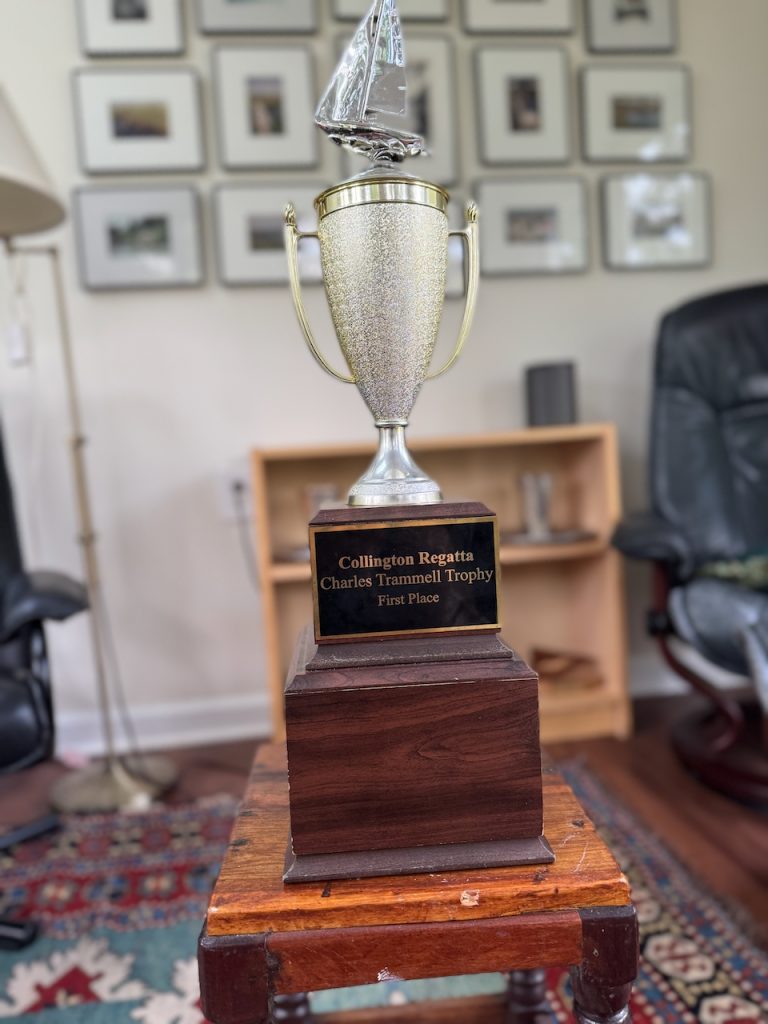
But I will say this: that for the remaining years of my life—which I know will be spent here at Collington—this will surely be one of my favorite memories. The trophy now proudly sits atop  my racing trophy case (and will remain there until next year when I must give it back for the next Collington Annual Regatta.)

Thank you, Collington, for the Big Sailing Regatta.


Visit me on Substack!
Subscribe to my Substack!

Collington Update

Some of you who follow my blog (and for which I am deeply grateful!) may have observed an unusual period of silence. Do not be disturbed. Embry and I are fine. I seem to have found myself bogged down by a combination of aggravated Trump-despair combined with my latest cause to try to preserve a swimming pool at Collington, the latter activity putting me at odds with the establishment.

For the record, we love Collington. The grounds are gorgeous, our cottage terrific, the food good, the staff excellent, the residents friendly with interesting careers and fully engaged with the world, and we are making new friends. One could not ask for more.

Except for one thing: the permanent loss of a 25-meter, indoor lap pool, which ironically was one of my chief recommendations when I did the initial feasibility and programming work for Collington in 1981 and which has continued to be very popular for  a group of 50-70 people who use the pool several days a week for water aerobics and lap swimming. I have been swimming laps myself for about 30 minutes per swim, three times a week and love it. It is also important for attracting new residents.

 The reason the pool will soon disappear is to make room for a new assisted living center, which will replace the original, which most agree is outmoded. This is all part of an ambitious initiative called “Collington Vision 2030,” which will add 55 new units, enlarge the dining room and bar area, add a whole new section called “Main Street” along with smaller upgrades and additions. The problem is that the pool will not be replaced (though a new site for it has been identified) due to insufficient funding. The total project cost is estimated to be $165 million without the new pool, which would add another $5 million to the price tag. Management has stated that the rollout of the new plan is essentially final even though residents were excluded from the initial planning process, leaving many residents distressed. So far, no budging though I have pointed out that the cost of $5 million amounts to only three percent of the total cost, not including the pool and that this gap could be addressed with minor changes to the overall scope.

What is especially troubling to many people is that management has stated emphatically that if the residents want a replacement pool, the residents should pay for it along with providing funding for enlarging the auditorium, a total cost burden to residents of almost $10 million. Except for perhaps a very few people, residents here are not wealthy. We are retired social workers, high school teachers, college professors, doctors and nurses, researchers, engineers, clergy, small businesspeople, and government and foreign service workers. We have writers, artists, musicians and singers but few, if any, multi-millionaires. The cars in the parking lot are mostly old and not expensive, and many are hybrids or EVs.  Requiring residents to raise funds to replace amenities taken away by management with minimal input from residents is unheard of in the senior living industry as far as I can tell and a complete mystery as to why Collington and Kendal are taking a hard line position. I have not thrown in the towel yet.

So rabble rousing about this potential train wreck has been keeping me busy and is why I haven’t blogged recently. But a lot of other things are happening here which I am very happy about. I was asked to do a single person show in the main front lobby area of some of my photographs, nine in black and white and nine in color, and that exhibit opened yesterday. Next month I have been asked to do a “neighbor talk” in the auditorium. And this Friday is the popular annual Collington Sailing Regatta, where six miniature skipjacks compete in our small lake. I have been practicing for several weeks along with five other skippers, who like me  have electronic devices that communicate with these 40-pound replicas, adjusting the sails and rudders. It is fun but very tricky and a whole lot harder than the real thing. The entire community comes out and people bet on the winner. Stay tuned for the results. (I came in DFL in the last practice, due I argue, to a weak battery on my controls.)


Visit me on Substack!
Subscribe to my Substack!

Humbling Moments

(Note to reader: this is the first of a new series, which I am calling simply “Life Stories” and will post these from time to time.)

Humbling moments, we all have them. Here is one (of many) that I remember.

In 1968 I was in my final year at Union Seminary in New York. I had struggled with theological issues and matters of faith for some time but had decided to stick it out at Union, lacking other better alternatives. Besides, by my last year at Union, I had managed to finagle a fieldwork assignment at the New York City Department of City Planning, and I was taking city planning courses at Columbia. My senior thesis was titled something like “Making Public Housing Human: Creative Playgrounds in New York City.” I still wonder why Union allowed me to get away with these activities. But, hey, it was the Sixties, and everything was up for grabs.

While I had struggled along the way at Union, I had not thrown in the towel yet and told myself to close things out I should take a least one more course in theology. I chose a seminar on contemporary theology taught by the famous theologian, Daniel Day Williams. Professor Williams was a kind and gentle person, who had written many books on theology and had a world-wide reputation. The seminar was open only to Union Seminary seniors and PhD students from various universities in New York City and very hard to get into. I still have no idea how I made the cut, but I did and realized the first day of class that I was in the Big Leagues. While it was labeled a seminar, there were probably around twenty people in the class, mostly graduate students from Columbia University and a Catholic institution of some sort. There were only a couple of other Union seniors besides me in the class and a lot of very enthusiastic PhD students. The atmosphere was electric, sitting at the foot of a theological icon, one of the few intellectual giants left at Union after the departures of Paul Tillich and Reinhold Neibhur. Everyone had to choose a theologian, write a paper on that person, and deliver a presentation of about 20 minutes about the person and his or her theology.

The first day Professor Williams passed around a paper with a list of famous theologians. I was one of the first to see the list as it was passed around and jumped on Paul Tillich, putting my name in the designated space. I could see others beside me frowning and sighing when they saw his name crossed out. I had hit the jackpot. Paul Tillich, probably the most famous living theologian in the world at the time, recently retired from Union and now teaching at Harvard, and I had lucked out in getting to write about him and his views.

Now Tillich was not new to me. In fact, in some ways he had already had a profound impact on my life. During my senior year at Davidson, Tillich had accepted an invitation to spend three days on campus and deliver a presentation each day in the school’s assembly hall. I attended all three lectures (which later became part of one of his books), sat in the front row of a jammed auditorium, took copious notes, and concluded he was the most profound thinker I had ever heard. That had happened four years earlier, and while I remembered the experience I could not remember exactly what he had said. This would be my chance to dig deeper and to come closer to the meaning of life. So I jumped in and got to work, reading several of his books and most of his opus magnum, Systematic Theology.

My presentation did not happen until week number four, which meant that I had three chances to listen to other students make their presentations. I had never seen anything at Union like the enthusiasm or engagement of my fellow classmates, with eager hands raised after each presentation, and thoughtful questions. During this preparation period I worked hard knowing that the pressure was on to reach the high standards set by the six or seven students who had made brilliant presentations before me.

There was only one problem. The more I read of Tillich’s writing, the less I understood. What he was known for was using terms like “ultimate concern” and “ground of being” to help make religion more relevant to the modern world. But the more I read, the more confused I became.

As the deadline approached, I started to panic, and the night before my presentation in desperation I called a PhD student at Union and a good friend and told him of my plight. He calmed me down, invited me to come to his apartment, and we began around eight in the evening to go over the main points of Tillich’s work. At six the next morning we were still working on it. My friend was extraordinarily patient and went over each concept as long as it took for me to understand it. I had never pulled an all-nighter before (or since), but by nine that morning I thought that I finally had Tillich figured out. I went back to the library and revised my paper and presentation, finishing by three in the afternoon, an hour before the seminar would begin.

I was the second of three presentations that day. The first was by a PhD student at Columbia about some obscure theologian I had never heard of, but whoever he was, he must have been profound because hands immediately went up around the room with questions, comments and replies. Just like the several presentations before hers, there was warm applause at the end and a smile on Professor William’s face.

Then it was my turn.

I walked to the front of the class, and bleary eyed, looked at the eager faces in the room, took a deep breath and launched into my twenty-minute presentation on the theology of Paul Tillich. When I finished, I smiled with satisfaction. I was so exhausted, I could not remember what I had said but felt a great sense of relief that I had managed to deliver my report and thanks to my friend, I had confidence I had nailed it.

 There was complete silence. Professor Williams, with a puzzled look on his face and raised eyebrows, asked the class, “Any questions?”

There was not a single peep. Some people were looking down at their desks to avoid eye contact.

“Thank you, Mr. Howell, you can now go to your seat,” the kindly professor said trying to manage a smile. There was no applause like all the other students had received.

“Well,” I said to myself, “I have either knocked the ball out of the park or somehow have totally missed what Tillich was all about.”

No one spoke to me when the class adjourned and as other student presenters were being congratulated.

I suspected that it might have been the latter, but I did not have a chance to talk to anyone about the presentation and was afraid to talk to the revered professor, so I kept quiet for the remainder of the class and for the rest of the semester, sitting at the back of the room and speaking to no one. I told myself that I could have been so profound that no one had any questions or maybe I could have been so awful that people were speechless. Better just forget about the whole ordeal. So, I shrugged it off and stoically finished the course. I would know soon enough when the semester ended and when I would receive my grade. Who knows, maybe I had nailed it. The final grade would tell. I could have gotten an A+. 

When the grades came in at the end of the semester, I held my breath and opened the envelope to discover a grade of C–, the lowest grade you could get at Union and equivalent to an F in most other graduate schools. There was not a single comment on the paper.

 I had my answer, but by this time the semester was over, Union and Columbia were on strike due to one of the student protests in the Sixties, and in the fall I was headed to planning school in Chapel Hill. A just and proper ending for my three years of suffering through theological education (and occasional anguish) at Union Theological Seminary in New York City. And one of my life’s many humbling moments.


Visit me on Substack!
Subscribe to my Substack!

AI: Friend or Foe?

Now that Embry’s two-year term as Senior Warden at All Soul’s Episcopal Church is up, she has been busying herself with finishing up writing the history of All Souls Church. Just for fun she fed the basic facts she had been gathering regarding liturgy at the church into her computer, hit the “Google Copilot” key and in less than a minute appeared two pages of perfectly worded prose, which was accurate enough for any final report. Oh, my Goodness!

 AI can certainly be your friend. If you have ever been a church goer or perhaps more unlikely still attend church, think of how many bad sermons you may have heard. AI could fix that in an instant if a clergy person identified to AI a Biblical chapter and verse, gave it a preferred length or time limit, the intended audience (liberal, conservative, MAGA, etc.) and bingo, out would come a meaningful and compelling sermon. Who knows, this may already be happening. Ditto for teachers, college professors, writers, editors and many other professionals. Your friend is patiently waiting for you. Just provide instructions and guardrails.

But be careful. Ai can be crafty. This week we are with our son Andrew’s family at a beach town on the New Jersy coast. Just for fun, his wife, Karen, suggested we feed AI  one of my recent blog posts critical of Trump and ask AI to rewrite the post in the style and language of the President.

Here is the blog post Karen fed to AI:

Every day it seems there is a new revelation of a Trump atrocity or excess. This week it was about all the money he and his family have made the past year, most of it after he was inaugurated—a net worth increase to the tune of $2.9 billion, according to Forbes (April 2025)—and we are now only at the beginning of his second term. Trump casinos, Trump championship golf courses, and Trump high rise luxury hotels seem to be on the drawing boards all over the planet, and there appears to be no end in sight. The new “Executive Branch” in Georgetown, a club just started by his oldest son, which hints of special access to the President for a mere $500,000 membership fee, is reportedly already a hot ticket item, and Trump’s bit coin business is booming. And having your own personal, multibillion dollar, luxury jumbo jet, compliments of Qatar, is shrugged off by the President as nothing unusual. Nor has there been a peep of outrage among members of the Grand Old Party, which in days of yore has stood for good government, anti-corruption, and fiscal responsibility. Fearing being “primaried out” by MAGA extremist candidates financed by Elon Musk and other billionaires, formerly moderate Republican senators and congressmen have caved. Using Trump’s words, “The world has never seen anything like it.”


Here’s that passage rewritten by AI in a Trump-style voice:

The fake news media is at it again, folks! They’re going absolutely crazy – and I mean crazy – because we’re so successful, so incredibly successful that even they can’t ignore it anymore. Forbes – and by the way,  they used to hate me, now they have to admit the truth – they’re saying we’ve increased our net worth by $2.9 billion! Can you believe it? $2.9 billion!

We’re building the most beautiful Trump casinos, the most magnificent championship golf courses – probably the best golf courses in the history of golf courses – and luxury hotels that are so spectacular, so amazing, that world leaders are calling me up saying “Sir, we’ve never seen anything like this before.” It’s true!

My son – and he’s a very smart guy, gets it from his father – he started this fantastic club in Georgetown. The Executive Branch, they call it. Very classy! People are paying $500,000 just to be members because they know quality when they see it. The waiting list is tremendous, absolutely tremendous.

And the bitcoin business? Through the roof! Nobody does crypto better than Trump, believe me. Even the haters have to admit it. Qatar gave us this incredible jet – the most beautiful jet you’ve ever seen – because they respect strength. They respect success.

The Republicans are finally learning how to win again! They see what we’ve accomplished and they’re saying “This is how you make America great!” No more of the old, weak politics. We’re making deals like nobody’s ever made before. The world has never seen anything like it – and that’s the truth!

Be careful. AI  can also be your enemy. You may get more than what you asked for. And who knows how much damage has already been done and how much more is to come? 


Visit me on Substack!
Subscribe to my Substack!

How Worried Should We Be?

Today (August 11) in The Washington Post is a front page story that hundreds of FBI agents are being deployed to fight crime—primarily street crime—in the District of Columbia and a similar article in The New York Times that in addition to the FBI, Trump is planning to send in hundreds of National Guard troops this week “to keep order” in the nation’s capital. All of this is happening at a time when the crime rate in the District of Columbia is close to historic lows. Several previous articles in various newspapers have said he is planning to abolish home rule, fire all DC elected officials, and appoint lackeys and sycophants to do his bidding—which includes his plans to expand the White House by constructing a gigantic ballroom. Such an action would normally take years for approval by regulatory agencies. Not if Trump’s henchmen are running the show. Trump was also quoted that within a matter of days there would be no signs of homeless people or encampments in DC. What does that mean? What does he plan to do with those people? And this is happening at a time when masked ICE officials with ambitious arrest quotas are now arresting people on the streets in poor DC neighborhoods and adjacent counties who look like they may be immigrants or speak with a dialect. And what about the massive prisons being constructed around the country to be run by private prison companies to house undocumented people in cages and to separate families? I tell myself that this is just a bad dream. But it is happening.

So how worried should we be?

According to the U.S. Constitution, checks and balances are in place to prevent autocratic rule in the United States. There are three branches of government—the executive, legislative and judicial branches—which share the responsibility for governing. But what if  both other branches are compliant with whatever the executive decides? Republicans control both the House and the Senate and have a majority on the Supreme Court. It appears that there is nothing Trump can do that will cause more than one or two Republican Senators or Congressmen to break rank. And the final guardrail—the Supreme Court—is shaky. Many lower courts have ruled against Trump’s agenda, especially those courts where a majority of judges have been appointed by a Democrat. Ultimately most of the controversial cases will end up in the Supreme Court where Trump seems to have four solid votes for whatever he wants and three justices appointed by a Democrat who will fight his moves, leaving the outcome to be decided by Chief Justice Roberts and Amy Coney Barrett, both Republican appointees. In times past the Supreme Court has been the final guardrail keeping our democracy from going off the cliff. Not so much today.

So how worried should we be?

It is too early to know what kind of pushback will happen regarding sending in the FBI and National Guard to take over law enforcement in DC and what the chances are that Trump will be able to pull this off. But what if he does? What does this say about our democracy and our way of life not only in the District of Columbia but in our country? If Trump can pull this off in DC, which cities might be next?

So what should those of us who are horrified by Trump’s actions do? I written checks to the ACLU and to CASA, nonprofit advocacy organizations which are championing the immigration cause, and attended last week a session about what we should do when we see ICE arrest someone (mainly document with our cellphone cameras), but that does not seem like very much. We can support Democrats running for the Congress and the Senate in 2026 but that seems like a long way off, and so much damage can be done between now and 2027 when Democrats would have a shot to having a majority in at least one of the legislative chambers. We can speak out and demonstrate when given the opportunity, join marches, and post blogs like I am doing now, but all that too seems futile.

And the fundamental question is this: why do good people turn a blind eye or sit on the sidelines when they know that what is happening is wrong? Most people, I believe, are fundamentally good and want to do the right thing. Hillary got into trouble when she said something like all the MAGAs are not evil people (implying that a lot are). I do not believe that all Trump supporters are bad people. What I do believe is that we Homo sapiens are fundamentally herd animals. We have the capacity both to love and to hate and fight back when we feel threatened. This is the nature of our species. We have evolved over many thousands of years from being the hunted to the hunter and for now due to our tribal organization we rule the roost on the planet Earth. Tribalism has enabled this to happen. But every tribe has a leader. That is why good leaders are so important and bad leaders are so dangerous.  I think you could make a good case that the critical factor which determines whether a country tilts toward good or to evil is the leader of the tribe. The Germans under Hitler were not all evil people. Nor were Italians under Mussolini, the Spanish under Franco, the Russians under Stalin or the Chinese under Mao. Yet many in those countries did terrible, evil things because of their tribal leaders. That is what we humans do.

And that is the situation we are experiencing today. The tribal leader of the United States is a narcissist wannabe dictator. The challenge for us today is how do get out of this mess. The main hope we have, I believe, is for strong new, younger leaders to speak out and to rally us herd animals to a vision of inclusiveness, fairness and kindness—all of which are part of our human nature, just as much as our capacity to do bad things to one another. Who will that be? When will that happen? How much time do we have?

That is why today I am announcing my candidacy to become the next President of the United States.

Send money.

(Ok, just kidding.)

But that does not answer the fundamental question of how worried we should be or what we should do about it. What do you think? What are you planning to do?


Visit me on Substack!
Subscribe to my Substack!

Mortality

So instead of complaining about how bad Trump is and how he is taking us down the dark road of authoritarianism, let’s ponder another cheerful topic, death. Now that Embry and I live at Collington, a continuing care retirement community of over 300 independent living units plus assisted living and memory care, it is impossible to ignore that all human beings die. Collington has over 400 residents whose average age has got to be in the mid-eighties or even older.  Between 35 and 45 people die every year averaging close to one every week. You might conclude that being reminded on a regular basis that there is a beginning and an end to human life is depressing, but  it is not. That is just the way it is for us Homo sapiens on the planet Earth. Most old folks here at Collington—as is true I suspect for all CCRCs– are survivors. We have lived long lives, outliving our life expectancy at birth by many years. Many here like us have much to be thankful for—wonderful children and grandchildren, satisfying careers, strong friendships, and generally good health. We all have also have made  mistakes and have had our share of hard knocks. Many of us have lost spouses. But I would say that in general we are the lucky ones. Most of us, I also suspect, focus not on the inevitable end of our lives but rather on getting as much out of life as we can in this moment, running our last lap. I have called it squeezing the last drops out of the lemon.

It is also true that the checking out process is much more difficult and painful for some more than it is for others. Disability, pain and memory loss are the major culprits, and few get a totally free ride. Like many my age, I occasionally glance through the obituaries in The Washington Post and am amazed at how many obits compiled by funeral homes start off with “so-and-so died peacefully, surrounded by friends and loving family.” Really? I don’t think that is the way it usually works, and sadly for some the experience is very painful. Some have been dealt very bad hands for the checking out process. Life (and death) is not fair.

The question lurking in the shadows for all of us humans– but especially us octogenarians and older–is, of course, what happens next. This is where I get into trouble. Now as some may know, I am a “cradle Episcopalian” who has attended church regularly for my entire life except for a couple of lapses due to church fatigue. Embry has been more of a stalwart than me mainly because she loves singing in the choir. In any event we have hung in there through the various ups and downs, scandals and recoveries of the Episcopal churches we have attended. I even graduated from Union Theological Seminary in New York City and for a short while was a “postulant” in the Episcopal Church headed for ordination. Fortunately for me, my bishop was a feisty old guy with a big heart, a good sense of humor and a keen eye for people like me who had trouble with all the theological baggage and no business becoming an Episcopal priest. He did me a huge favor by advising me that for every year spent at Union— “that heretical Protestant seminary”- I would do “penance” at Nashotah House, an Anglo Catholic, hardcore, orthodox Episcopal seminary in the backwoods of Wisconsin someplace. Easy call and we parted ways.

Where I get into trouble is that even though I have stuck it out in church attendance, I continue to have the same nagging questions that so many others have about what happens next and what this short, fragile life is really all about.  We Homo sapiens are just one of many thousands of species who over a course of millions of years evolved and eventually clawed our way to the top of the food chain.  We live on one small, beautiful planet circling a run-of-the-mill star in a nondescript galaxy in a universe that scientists now believe contains something like a trillion galaxies. All this began with a “Big Bang” some 13.8 billion years ago and is still expanding with mysterious “dark matter” and black holes somehow holding it all together.

Can any of us Homo sapiens really figure out what all this means? Sorry, above our pay grade.

And yet we think we are it? That no “advanced life” exists anywhere else?  That a divine deity we call “God” created us in “His image” and that when we die—if we believe the “right things”—we will go to heaven and live with Him for eternity? Well, that is what many who call themselves Christians say they believe. And many of those people also believe that if you do not believe the same thing they do you are going to spend eternity burning in hell, which some still believe is located near the center of the Earth.

Please.

Now you know why I was not ordained.

This year I attended a funeral of a dear friend. At the end of the service, the Presbyterian minister proclaimed that he had no doubt whatsoever, “absolutely none,” that this fine person now deceased was sitting in heaven with God on his right and Jesus on his left. When I complained to a friend that I thought this was going a bit too far, he responded, “Joe, if you do not believe this, number one, you aren’t a Christian and number two, if you do not believe that, life is not worth living.”

I immediately changed the subject.

But what you don’t believe is not a substitute for what you do believe and here I have to admit I fall woefully short. I do not have an answer as to what happens to us after we die. The answer to this, I believe, is that we have no choice but to live with the uncertainty. What we can do is celebrate the lives of those we lose, mourn for their loss and comfort those in pain. And we can be thankful for our own lives and those we love on this extraordinary planet. 

I know that there are those reading this that are asking, ok, I get it, but why has this guy stuck with church all these years. I have been asked this question more than once. My answer is that religion in general–and Christianity in particular–offers glimpses of a dimension of human existence that falls into the category of the spiritual and that this dimension is real and part of what it means to be human. I am not giving up on that, and being associated with a church, warts and all, has been for me a pathway to access the spiritual dimension of life and to be part of a loving and supportive community. And the Chrisitan message of unconditional love, the call to love your neighbor, to respond to those in need, and to try to make the world a kinder, fairer, and gentler place is enough to keep me going.

At least for now. Before it is my turn to say goodbye.


Visit me on Substack!
Subscribe to my Substack!

Five Alarm Fire

July 4, 2025 is now history. Our beloved country as a functioning democracy is officially on life support. All that Trump wanted he got and now officially owns the Republican Party. All kinds of postmortems are coming in, all of them bleak. Hundreds of thousands of undocumented immigrants will be rounded up in the months ahead, many sent to “dark prisons” in places like El Salvador and Sudan. The “Alligator Alcatraz” prison in the swamps of Florida is supposed to open immediately housing 5,000 undocumented people—in cages! Other similar giant makeshift prisons are planned around the country. There are more than 13 million undocumented people in the United States. Many industries—like construction, hospitals, long term care and assisted living, hotels, restaurants, and agriculture depend on them. If Trump’s goal is to get rid of all of them in four years, that would mean arresting, locking up, and deporting about 65,000 people a week or over 9,300 every day. That probably won’t happen but a lot of suffering will. The “Big Beautiful Bill,” which is now the law of the land, has  billions in funding for immigration and the expansion of ICE into what many describe as Trump’s personal police force and the largest federal police force in U.S. history. Trump now has the money to make a lot of this happen.

The immigration issue ranks at the top of my list of Trump atrocities because of the pain and suffering it will inflict on people whose only “crime” was to try to make a better life for themselves and their families. Embry and I are very close to several undocumented immigrant families. They now live in a world of terror.

But that is just the beginning. To make permanent and expand the massive tax breaks for the ultra rich, deep cuts will be made to Medicaid, the ACA (Obamacare) subsidies, and to SNAP (food stamps). What is going to happen to the people who depend on these services? The CBO estimates that over 17 million people will be affected. Many hospitals serving inner city neighborhoods and rural areas will likely close.

The irony here, of course, is that Trump and his allies now proclaim that they are now the party of the working class. The working class did shift in large numbers to vote for Trump, responding to his anti-establishment, populist rhetoric. Well, Trump’s policies will devastate many of the working class people who switched from Democrat to Republican. Classic bait and switch.

And then there is the dismantling of USAID and the termination of most of the vital aid to struggling people in Africa, parts of Asia, and struggling countries throughout the world. Experts estimate the lives lost could total hundreds of thousands or higher. And what about all the USAID workers who are now without jobs? What about the transformation of the government workforce from professional public servants to Trump sycophants and MAGA loyalists?

The list continues: ending subsidies for combatting climate change initiatives, providing subsidies for polluting industries, attacks on education, especially elite colleges and universities, drastically cutting funding for science and medical research, attacks on all things LGBTQ, trans gender, and “woke,” and massive amounts of dollars for expansion of the military. Trump’s excessive tariffs are supposed to start any day. And this is just for starters. With a Congress controlled by Republican Trump sycophants and a friendly U.S. Supreme Court, who knows what other nightmares Trump and his followers will come up with?

And, finally, there is prediction by the CBO, that these initiatives will add at least $5 trillion to the national debt, a dire situation which no reputable economist believes is sustainable without wrecking the economy.

Have you heard enough?

Well, what are you (we) going to do about it? Friends, we are witnessing the igniting of a five alarm fire. My generation has been lucky. We missed World War II, and most of those pursuing higher education got out of the draft during the War in Vietnam. The economy has prospered, and the country has made great advances in science, medicine and technology. We have started to address latent racism and have strengthened social and healthcare safety nets. Jobs have been plentiful for those seeking them. We have  avoided full scale war and a nuclear holocaust. And we also had the civil rights movement, which both Embry and I were involved in and which  we both see as a pivotal moment in our lives.

At the same time economic disparities have worsened starting in the early 1980s. Racism and prejudice against people with different appearances or sexual orientations stubbornly persist.  Working class incomes have stagnated, and there has been backlash from the working class regarding perceived elitism by those with college and advanced degrees.

I think that the Civil Rights Movement of the 1960s followed by the Antiwar Movement of the mid 1970s may offer some hope for the future and some guidelines as to how to begin to extinguish the five alarm fire unleased by Trump and his Republican and Supreme Court allies.

 Here are the lessons learned:

Don’t expect the Democrats to put the fire out. Neither Democrats nor Republicans were part of the Civil Rights Movement until very late in the effort. The movement was grass roots and   started in earnest in 1961 with the  freedom rides to Alabama and the sit ins in Greensboro, NC, and quickly spread to many other parts of the South. However, these actions were not spontaneous. There were lots of people and organizations involved in the planning and execution of the resistance effort—the NAACP, CORE, SCLC, SNCC, the National Urban League, and several other groups. Progressive churches and other religious institutions were also important. To fight Trump and his agenda, we need organizations united behind the effort and we need money and sound planning. This is starting to happen. The No Kings Protests attracted over four million people. But more organizations need to step up  and more planning needs to happen. Organizations like the ACLU, CASA, SPLC are leading in pushing back on immigration, but more will be needed along with resources and money.

We also need strong, charismatic leaders. The leaders of the Civil Rights Movement made a huge difference. Martin Luther King was the most prominent but there were many more—James Farmer of CORE, Stockley Carmichael and John Lewis of SNCC, Whitney Young of the Urban League, Malcom X, Caesar Chavez and many others. Most of these leaders were at the time under 40. We need younger people to step up, speak out, and take leadership roles.

We need nonviolent mass demonstrations and nonviolent civil disobedience.

We need massive voter registration drives for the 2026 elections.

We need celebrities and progressive business leaders to speak out.

We need mainstream progressive religious groups—Protestants, Catholics, Jews and Muslims–to speak out.

Most important we need to win back the working class and motivate them to get Democrats elected in 2026.

All is not lost. Trump will surely overplay his hand. What he is doing is enormously unpopular. The charge for the Opposition is to broadcast what his policies are doing, how they are destroying people’s lives, and how they will ultimately destroy our democracy. Don’t give up hope. The 2026 midterm elections are just over a year away. I predict that with a strong resistance and voter registration and motivation effort Democrats will retake the House and the Senate and put an end to this madness before it destroys more lives and our democracy.

In the end, however, we all have to step up to the plate. There is a great quote from Margaret Meade, “Never doubt that a small group of committed people can change the world. Indeed, it’s the only thing that ever has.”


Visit me on Substack!
Subscribe to my Substack!

Collington Stories (Number 7): Close Call

There are several truisms that come to mind regarding continuing care retirement communities in general and Collington in particular. Everyone is old, many in their late 80s and 90s. The vast majority are women, mostly widows. And all are survivors. This also means those of us living in CCRCs have stories to tell regarding the ups and downs of our lives and most of us have experienced losses. The vast majority of single people living here have lost a spouse. Some of us have lost children.

You might think that given the experiences we old folks have had and the health issues and challenges that many at our age face daily that there would be grousing, complaining and “organ recitals” on a regular basis. Not so at Collington. Embry and I have lived here now for almost three months and have not heard a whimper or complaint from anyone about their health or personal challenges. You could say “Collingtonians” soldier on, making the best of the years we have left, squeezing the last few drops out of the lemon. Even though a fellow resident may not know you, you can always count on a smile and a nod and often an enthusiastic hello from someone you pass by on the way to dinner or an event. The only complaints that you hear regularly are about Trump, climate change and his assault on our democracy.

In this post I am going to break the code of silence regarding health issues and tell you about a recent health scare I had, which I have not breathed a word about to anyone at Collington to avoid breaking what appears to be an unwritten code of silence about such matters. About six months ago I was diagnosed with high blood pressure, which I explained to the doctor was a direct response to Trump and the discomfort he is causing to so many. For the past several months the doctors at Kaiser have been tinkering with the dosage of three new   blood pressure meds, which have resulted in readings both significantly above normal ( 180-200 systolic instead of 110-120) or way too low (60-80 systolic). Progress is being made, but so far they have not figured out the right mix that allows me to maintain a consistent relatively normal blood pressure. The most recent challenge has been that the pressure has been on the low side, which is good since it does not signal that I am not on the verge of a stroke but bad because it causes dizziness and could cause me to pass out resulting in a head injury. But, hey, this is just part of the aging process, and the good thing is that doctors have a lot more to work with using medications which were not available for my father who had his first (of several) strokes when he was about my age.

My turn came last Sunday, June 22, when walking to the Kennedy Warren, our old digs, following lunch after church with a fellow parishioner at All Souls. I was in search of a cool place where I could lie down for a couple of hours while Embry worked on stuff to close down her stint as senior warden. The temperature was close to 100 with heavy humidity and a blazing sun. I had not walked more than a dozen steps from the restaurant when I had to pause to keep on my feet, then another dozen steps and more dizziness. I took a deep breath and told myself I could make it through the zoo crowd the next 50 yards to the top of the hill and the entrance to the zoo where I thought I might be able to find a bench in the shade. I got about halfway to the top of the hill when I became very dizzy. At the very moment when the world was spinning around me and I could feel that I was going to pass out, two friends from the Kennedy Warren suddenly appeared before me on the crowded sidewalk, a retired family doctor and his wife, a retired nurse. He grabbed me under one shoulder and his wife under the other, and they guided me up the hill and then toward the Kennedy Warren as we nudged our way between the sweltering zoo goers. With great difficulty we made it to the lounge area in the cool lobby of the K-W where they sat me down on a comfortable couch. My doctor friend excused himself while his wife encouraged me to rest and stay calm. Minutes later he returned with a huge bottle of Gator Aid and a portable blood pressure device (like the one I have at Collington to measure my blood pressure several times a day), and after reading the numbers exclaimed in a panic that he was dialing 911. My systolic blood pressure reading was in the low sixties, a miracle, he said, that I had not passed out. But I surely would have if he and his wife had not come along at exactly that moment. The 911 operator asked what insurance I had and then passed the call off to the “emergency nurse” at Kaiser, who directed me to go to the nearest Kaiser Urgent Care Center. He offered to call a Lyft at their expense and promised that we would be first in line when we arrived. The Lyft ride did not show up, but my friend ordered an Uber, which he paid for, and drove both of us to the Kaiser Capitol Hill Urgent Care Center, about a 30 minute drive. As promised, we were first in line, got to see the urgent care nurse and then a very sharp doctor within minutes where they gave me more Gator Aid and cold water, checked my blood pressure and vital signs, with my friend by my side, monitoring every move and providing encouragement.  After a few minutes my blood pressure was up to close to 100 and in about a half hour, I was rested and was free to leave. He adjusted the prescription, called for a new one for me to pick up at the pharmacy before we left, and made an appointment for me with my primary care physician for early the next week. Embry picked us up in front of the Kaiser office, and we dropped my friend off and headed home. Dodged another bullet, as they say. My guess is that most of my fellow residents at Collington have dodged their share of bullets.

Now how lucky was that! Just as I was about to pass out on a crowded sidewalk leading to the zoo, along come two people I knew—a retired doctor and retired nurse—who knew instantly that I was in serious trouble and knew exactly what to do. What would have happened if I had passed out? What were the chances of hitting my head on the sidewalk? What were the odds of this miraculous rescue happening at this time and in this place?

As Embry drove me home, I remembered reading a line from (I think) A Gentlemen in Moscow which said that “a coincidence is God’s way of remaining anonymous.”


Visit me on Substack!
Subscribe to my Substack!

Inching Toward the Abyss?

How afraid should we be at this moment? Let me count the ways:

Trump is going all out on ridding the country of undocumented immigrants. The needless pain and suffering he is causing is beyond the pale. There are all sorts of stories of kids five or six years old or younger whose parents were ripped out of the car by masked ICE workers fully armed leaving the kids alone and abandoned. Trump has taken control of the California National Guard and ordered  the marines to energize immigrant arrests and expulsions. While Los Angeles is getting hit the hardest, Trump has warned that this is just the beginning. No city is safe. Blue cities and blue states are next, and sanctuary cities are top on the list. Due process  is being  ignored and will continue to be ignored  as long as Trump can get away with it.  Top aid Stephen  Miller just announced that by the end of the year, one million undocumented immigrants will have been deported, and hinted that by the end of Trump’s  second presidential term they all will be gone. Friends, there are between 12 and 13 million undocumented people living in the U.S. They make up over five percent of the population and a considerably higher percent of the work force. Industries like construction, hospitality, agriculture, long term care, restaurants, landscaping, and many others on depend on them. They do the heavy lifting no one else wants to do. Not only is this unbearably cruel. It is stupid, will harm the U.S. economy, and will cost billions.

Israel has just bombed Iran in the most lethal bombing yet. Iran is retaliating. Many believe that this could quickly get out of hand leading to a regional war or worse. Trump is doing nothing for now. We could get drawn into this and do not know where it will lead, yet our diplomatic acumen is a thing of the past.

The war in Ukraine lingers on with more drones killing people in major Ukrainian cities and also in Russia. There have been over a million deaths and casualties on the Russian side, fewer on the Ukrainian side, but a higher percentage of the population. There is no end in sight. Russia has more nuclear weapons than any country including  the U.S. (which has close to the same number, just over 5,000). What are the chances that one mistake or miscalculation could lead to a nuclear holocaust?

The U.S. has given NATO the middle finger and told them in so many words that what is happening in Ukraine is their problem, not ours. Putin and Kim Jon Ung continue to be Trump’s buddies.

The largest military parade in U.S. history—with 7,000 soldiers, dozens of massive tanks and missiles, planes, helicopters and paratroopers)  will happen today, Saturday, June 14, celebrating Trump’s 75th birthday (and, yes, the army’s 250th anniversary, but really does anyone think that this is a coincidence?). Trump has threatened dire consequences to anyone who protests.

The war in Gaza continues every day with body counts of innocent victims whose bodies are beneath the rubble of yet another building destroyed. And for what reason? Aid trucks are still on most days stalled at the border. Trump’s solution? Move them all out and build towering casino’s and hotels along with another Trump golf course and resort.

The health care system is now led by a nut case who does not believe in vaccines and has replaced  all the experts in the public health leadership team with people who agree with him.

Thousands of federal workers have been arbitrarily laid off by “genius” Elon Musk and a bunch of whiz kid, tech DOGE bros for no apparent reason except to limit the size of the federal  government and to cut costs including  aid to poor countries. If this stays in place, thousands will die. Many are already dying, and the desperate pleas for help you see on television news are heart breaking.

While it is becoming apparent that maybe extreme tariffs are not the smartest thing for the U.S. or the world economy, there is no assurance that the TACO President (“Trump always chickens out.”) will back off before scarcities of goods start to happen, U.S. businesses fail, and prices skyrocket.

Trump is doing everything he can to cut every environmental regulation he can and reenergize the fossil fuel industry.

Government programs like SNAP, the Affordable Care Act, and Medicaid are all on the chopping block in Trump’s “Big Beautiful Bill,” and Medicare and Social Security are likely to follow.

The billionaire class is about to get the biggest tax break ever, resulting in massive federal operating deficits and adding between  three and five trillion dollars to the national debt, a  dire situation which no reputable economist in the country believes is sustainable. Trump’s Big Beautiful Bill if it becomes law will result in the largest transfer of money and wealth from the poor to the rich in the history of the Republic.

And Trump has declared war on higher education, withdrawing financial support from major colleges and universities, threatening to bring them to their knees. He has also gone after major law firms, most of which have caved and agreed to his bidding for free.

Watching over this is a morally and intellectually bankrupt Republican Party, which when the Boss says jump, responds with “how high.” And they are the ones who have the majorities in both the House and the Senate.

Few guardrails are left. The adults in the room during Trump’s first term are out and a group of sycophants and extremists are in with Trump’s cabinet labeled by many as the worst of all time.

What have I missed?

Oh, yes, Trump’s war on all things DEI and his overt racism.

The question is whether there is a silver lining. The courts appear to be (for now) the only hope we have for softening the blows, but six of the nine justices are Republican presidential  appointees, including three by Trump. The only two who might save us from catastrophe are Barrett and Roberts. Pray that they will save us. But will Trump obey a Supreme Court order he does not like? If he doesn’t, then the American experiment is over.

But there are signs of hope. Trump’s popularity is plummeting in recent polls. Massive demonstrations will happen in all 50 states today,  Saturday, June 14, proclaimed  “No Kings Day.” People are speaking out. Newsome’s resistance and comments are inspiring.  Despite the apparent disarray of the Democratic Party and its gerontocracy, people are starting to step up. Younger, fresher faces are emerging.

And most of all, we are not bad people in America. Yes, we are a nation in turmoil and discontent (much of which is due to social and economic inequalities), but there are many people who want to do the right thing and there are many MAGAs who must be beginning to realize that they have been sold a bill of goods. Trump has pulled the country’s biggest bait and switch. For now the courts have not caved, and in only a year and a half there will be new elections for Congress. A court ordered Trump to turn over control of the California National Guard to Newsome. There is hope. But it is likely to be a rough ride and could get worse, much worse, before it gets better.

So yes. We are inching closer to the abyss but it does not have to end that way. Fasten your seatbelts and fight the good fight. But keep it nonviolent. This worked in the Civil Rights Movement. It can work again.


Visit me on Substack!
Subscribe to my Substack!

Biting the Hand That Feeds You

On June 3 The New York Times podcast, “The Daily” featured an interview with New York Times  political correspondent, Shane Goldmacher, who had just completed a voting analysis of how every county in the country voted in the last three presidential elections. Boy, was this an eye opener! The shift in voting behavior in this election was staggering. In counties where there were significant numbers of low income and working class people, Trump made huge gains—and not just from white working class voters. More African Americans and Latinos also voted for Trump and switched their votes in large numbers from Democratic to Republican. His conclusion: In 2024 the Republican Party became the party of the working class in America due to the charisma of Donald Trump and his message trashing the Democrats as elitist. Goldmacher’s message was this: Trump owes his victory in large part to this switch in voting behavior and since there are more moderate income and working class voters in presidential elections than there are professionals, intellectuals, and highly educated people, if the Democrats have any hope of recovering, they must reclaim their former role as the party of the working class.

I was not surprised about the white working class, but African Americans, Latinos, and others with moderate incomes? I was shocked. What are those who switched their votes to Trump thinking? What do they see in Trump?

Trump, of course, is a fraud. However, he also has talent in marketing and communicating, saw an opening and pounced on it. He sensed the anger and despair so many feel who live from paycheck to paycheck. His message of revenge and retribution resonated with many who are struggling and the Democrats allowed him to get away with the Big Lie that he and only he will right the wrongs that ail America’s working class.

I am hopeful that it will soon become obvious to many people  who voted for him that fundamentally his polices overwhelmingly favor the rich and the superrich, not the working class. He has tossed them a few crumbs like no taxes on tips or overtime work, but the thrust of the Trump/ Republican budget bill now being debated is a huge giveaway to the ultrarich, partially paid for with cuts to programs which help those with modest incomes—Medicaid, SNAP (food stamps), the ACA, and affordable housing subsidies. In addition, Trump’s tariffs, the huge increase in the national debt due to tax breaks for the megarich and his trade wars will result in higher prices across the board along with higher interest rates, hurting lower income Americans the most. This is classic Bait and Switch 101.

Surely, when you lose your health care, your food stamps, and your rents go up and when the prices of essentials at the grocery store start to skyrocket, you are likely to ask the question, is this really what I voted for. It is only a matter of time. But how long will it take? And how much damage will have been done? Recent polls indicate that Latino converts are already having second thoughts as they see their neighbors handcuffed and carted away.

At this point it is not clear what will emerge out of the Senate. Trump can only lose three votes, and of the five or six Republican Senators who say they will not vote for the bill that came out of the House, it appears to be split down the middle between those who are against the cuts to Medicaid and SNAP and those who demand more cuts to social programs which help the working class in order to lower the deficit. How this ultimately works out is “to be continued,” but already there is pushback from Latinos who are terrified by the deportations and by others who depend on the social programs for survival. Good luck, Republicans, on keeping the new working class voters who helped elect you and Trump in 2024. So there is hope for the Democrats, but this  won’t happen until  the midterm elections in 2026 and lots of damage will have been done before the Democrats can regain control of the House.


Visit me on Substack!
Subscribe to my Substack!